Introduction
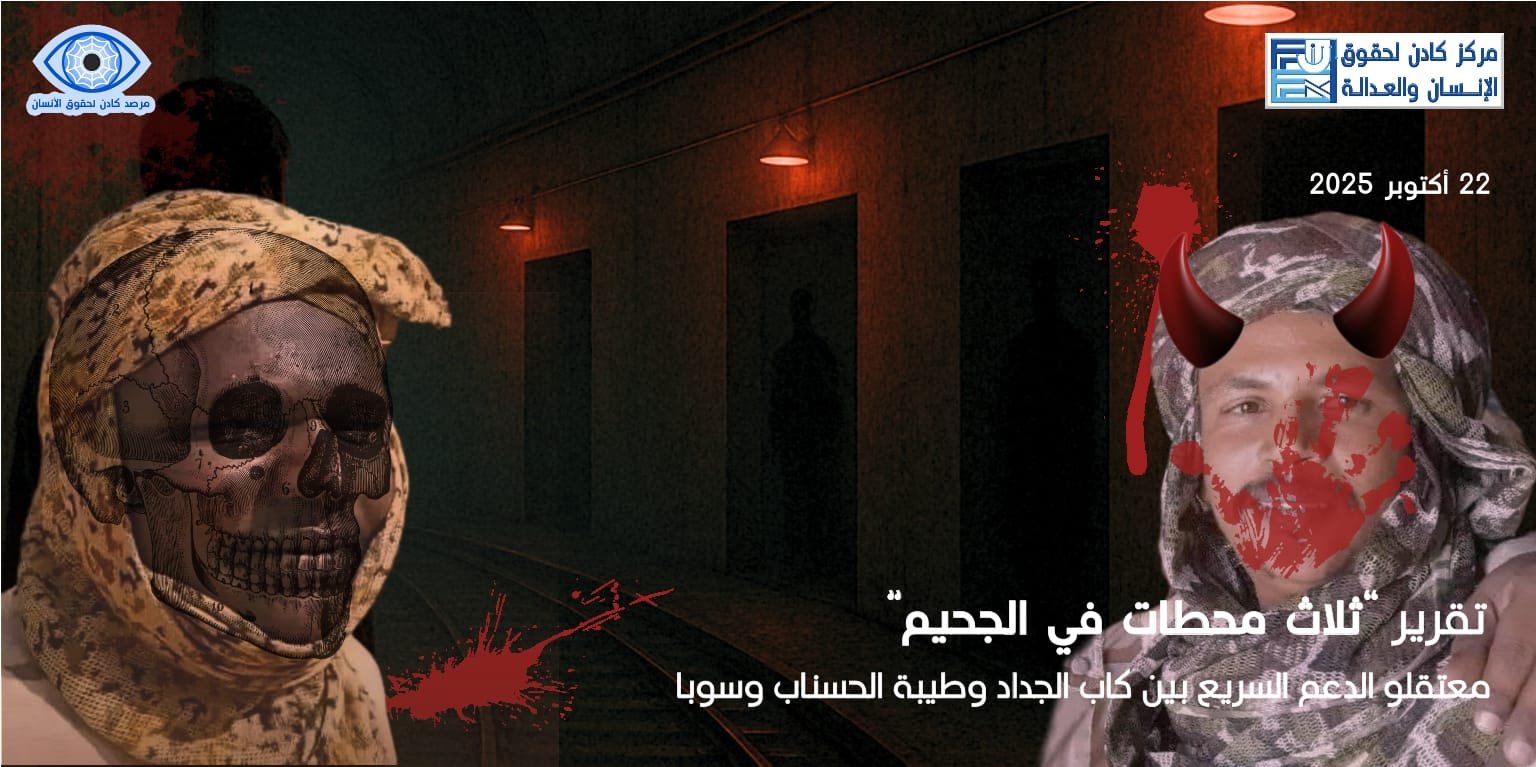
This report, issued by the Kaden Human Rights Observatory, documents the suffering of a group of civilians who were forcibly transferred between 3 detention centers belonging to the Rapid Support Forces in Gezira and Khartoum states during the second half of 2024. The story begins in the village of Al-Sareiha in northern Gezira State, following a bloody attack carried out by the Rapid Support Forces under the command of the field commander known as Omar Sharon, which resulted in the killing and wounding of hundreds and the arrest of at least 150 persons.
This report was completed after the withdrawal of the Rapid Support Forces from Gezira State and the return of the Sudanese Armed Forces to control of the area in early 2025, which enabled the Kaden Observatory team to access the affected villages and conduct direct interviews with victims and survivors of detention, in addition to collecting medical and field documents to identify the locations used as detention centers. The investigation relied on the testimonies of 3 detention survivors, along with corroborating accounts from local residents. Names have been withheld and replaced with initials for security reasons.
This attack came in the broader context of the ongoing war between the Sudanese Armed Forces and the Rapid Support Forces — a war that erupted in April 2023 and led to the collapse of state institutions, the disintegration of security agencies, and the spread of the conflict to new states. During the second half of 2024, the Rapid Support Forces sought to expand their control in central Sudan, including northern Gezira State, in an attempt to secure supply lines south of the capital Khartoum and sever the army's supply routes. In response, the army launched a general mobilization campaign and calls to arm civilians to resist the Rapid Support Forces and prevent their advance.
This escalation created a tense environment marked by a breakdown of trust and a rising tempo of violence against civilians. As Rapid Support Forces operations against villages suspected of sympathizing with the army intensified, patterns of collective punishment and retaliatory attacks against local residents emerged. The field commander Omar Sharon justified his attack on the village of Al-Sareiha by claiming that "the residents are armed and resisting his forces," asserting that the goal was "to subdue them by force." However, evidence gathered by the Kaden Observatory shows that these justifications were pretexts to justify grave violations against civilians, who found themselves trapped between two armed parties with no regard for their lives or the protection of their fundamental rights.
On the morning of Friday, October 25, 2024, the Rapid Support Forces launched their attack on the village of Al-Sareiha, using heavy 23mm weapons and anti-aircraft guns. The bombardment and assault lasted more than 6 hours, resulting in at least 124 deaths and the arrest of 150 persons, including women and elderly people. The detainees were marched on foot toward Kab Al-Jidad under degrading conditions, before being subsequently transferred to the Tayba Al-Hassanab camp and then to Soba Prison in Khartoum.
Testimonies and investigations reveal that what occurred was not an isolated incident but part of a systematic pattern followed by the Rapid Support Forces during their period of control over Gezira State, encompassing extrajudicial killings, torture, arbitrary detention, and deliberate deprivation of food and medical care. The report concludes that these violations were carried out under the direct supervision of field commanders in the Rapid Support Forces, chief among them Omar Sharon and his aide known as Qaja, making them rise to the level of war crimes and crimes against humanity under international humanitarian law.
Kab Al-Jidad — The Beginning of Detention and Torture
Kab Al-Jidad was the first stop to which detainees were transferred after the attack on the village of Al-Sareiha. The area lies on the dirt road connecting Al-Kamleen and Al-Hasaheisa — a low-lying agricultural area surrounded by fields and small villages — which the Rapid Support Forces used during their period of control over Gezira State as a temporary site for assembling detainees and civilians captured during raid operations. After the forces withdrew from the area, the Kaden Human Rights Observatory team was able to access the site in February 2025, where remnants of burned tents and metal floors used as makeshift detention rooms were found, along with iron tools, thick sticks, and broken water jars — all indicating that the place had been operated as a field site for temporary detention and torture.
Witness M.A., a farmer in his forties, stated that he was arrested along with a group of more than thirty persons from his village immediately after the attack ended, where their hands were bound with electrical wire and they were forced to walk more than ten kilometers. He says: "We were walking barefoot, and anyone who fell behind was beaten with sticks or rifle butts. Some of us collapsed from exhaustion and we never saw them again. We arrived at a place with tents and water jars, and there they ordered us to sit on the ground in the sun all day without food or water." He added that the soldiers hurled racist slurs at them and forced them to chant slogans in support of the Rapid Support Forces.
M.A.'s account matches the testimony of witness S.H., a young man in his twenties who was wounded in the leg during the arrest. He stated that the soldiers used systematic beatings as a means of extracting confessions, accusing the detainees of harboring army fighters inside the village. S.H. says: "They beat us with electrical wires and said we were protecting army soldiers. They would ask about specific names we didn't know, and if we didn't answer they would hang us from a nearby tree and whip us until we lost consciousness. Once, I saw a man beaten to death because they said he was hiding a weapon in his home." He noted that bodies were left in the open until evening and then transported in a small vehicle out of the site.
According to the Observatory team's analysis, the Kab Al-Jidad center served as a "sorting point" for detainees, where field supervisors decided the fate of each group: either released after days of detention or transferred to more covert sites for further interrogation and torture. One witness stated that a field officer known as Qaja personally supervised the transfer operations and issued orders to assemble detainees into groups of ten to fifteen persons. Witness A.R. says: "Qaja came on the third day with a Land Cruiser mounted with a Dushka machine gun. He told us we were going to a better place. We thought they would release us, but they put us in the vehicle and beat us with sticks the whole way until we arrived at the Tayba Al-Hassanab camp."
The investigation's findings show that living conditions in Kab Al-Jidad were extremely harsh. There was no adequate shelter or sanitation facilities, and detainees were forced to relieve themselves in the open and were denied water for long periods of the day as a means of humiliation. The Observatory team also documented dried bloodstains on the walls of one of the metal rooms used for solitary confinement, along with rudimentary tools believed to have been used for torture, such as wires and iron rods.
The Observatory concluded that the Kab Al-Jidad center was not a random or temporary site, as some Rapid Support Forces commanders later attempted to argue, but rather an organized detention point operating in direct coordination with senior field command. Testimonies confirmed that everything that occurred there took place in the complete absence of any judicial or administrative oversight, and that detainees were not permitted to communicate with their families or receive medical care — making what happened at Kab Al-Jidad a crime of mass detention and torture under international humanitarian law.
Tayba Al-Hassanab — Turning Civilians into Prisoners of War
After approximately ten hours of intermittent marching and forced transfer, the group moved from Kab Al-Jidad arrived at the Tayba Al-Hassanab camp located in Jabal Awliya district south of Khartoum. It was in the early hours of Saturday, October 26, 2024 — just one day after the attack on Al-Sareiha. The camp, which had originally been a former training site for the Reserve Police, was transformed after the outbreak of war between the army and the Rapid Support Forces into one of the largest Rapid Support Forces bases in Khartoum State. As the war expanded and arbitrary arrests increased, the camp was used as a dual-purpose site, combining storage of war materiel with the detention of civilians suspected of opposing the Rapid Support Forces or cooperating with the army.
According to the testimony of witness M.A., the moment of arrival at the camp gate was shocking: "They unloaded us from the truck. We were bound, beaten, and covered in dust. We stood in a long line at the entrance and there was a group of soldiers mocking us and laughing. One of them said: 'So, you people of the army — this is the end of your courage.' After that they threw us into an empty yard and told us to sit on the ground, and anyone who moved would be whipped." He noted that some detainees had open wounds, but none were permitted to receive treatment.
The site used as a detention facility was a section of the camp containing an old school with dilapidated classrooms whose windows had been sealed with tin sheets. According to witness S.H., the group was held in a cramped classroom no larger than fifty square meters accommodating at least sixty persons. He says: "The air was suffocating, the smell unbearable. Some people lost consciousness. At night there was no sleep because the guards would come every little while and beat people for no reason — just to hear the screaming."
One day after their arrival, an interrogation phase began. The stated objective was "to confirm their connection to the armed forces or their arming by the population" — a charge used by the Rapid Support Forces to justify detaining dozens of civilians during that period, within the broader context of their attempts to suppress any local resistance in their areas of influence. Witness A.R. noted that interrogation sessions took place in a separate room at the end of the corridor, where each detainee was summoned individually and questioned about the names of "armed individuals" in their area and any connection they had to the army. "They would bring us into a dark room where three men holding whips and wires were waiting. Any question you didn't answer would be met immediately with beatings. One of them would spray water on us and then administer electric shocks so the pain would be multiplied."
These testimonies were corroborated by what the Observatory team documented through medical and civilian sources in the area. A cooperating physician at Jabal Awliya Hospital confirmed that he received three bodies from Tayba Al-Hassanab during the last week of October, bearing clear signs of torture including skull and rib fractures. Despite Rapid Support Forces attempts to conceal the incident, photographs leaked from inside the hospital showing injuries consistent with descriptions provided in survivor testimonies.
On the third day of detention, a group of children and young adolescents was separated into a solitary room after being accused of participating in resistance to the attack on Al-Sareiha. Witness M.A. says that the children were flogged daily to force them to reveal the names of relatives who possessed weapons. One of these children, under severe torture, pointed to a detainee as someone who owned a hunting rifle. He was immediately taken out to an open yard and beaten until he lost consciousness. The witness adds: "We could hear him screaming, and after a while he went silent. They carried him away and we never saw him again. The next day we learned he had died."
Information gathered by the Observatory shows that the Tayba Al-Hassanab camp was not merely a makeshift detention facility but a central detention center affiliated with the Rapid Support Forces command in Khartoum, subject to direct oversight by field intelligence officers. It was used to detain both prisoners from the armed forces and civilians accused of assisting them — making the treatment these civilians received closer to the treatment of prisoners of war, despite their not belonging to any military formation.
On November 7, 2024, after approximately two weeks of detention, groups of detainees were assembled in a dirt yard inside the camp in the presence of a person who identified himself as a "legal advisor" named Abd Al-Basit. Witness S.H. says this man ordered them to stand in parallel lines and then began reading out "sentences" of life imprisonment or solitary confinement against some detainees — without any investigation or court, solely based on what he described as "field investigations." These sentences were purely formal, as all those sentenced were subsequently transferred to Soba Prison, which was at the time under Rapid Support Forces control.
Evidence gathered by the Kaden Human Rights Observatory confirms that violations at the Tayba Al-Hassanab camp included extrajudicial killings, systematic torture, deprivation of food and healthcare, as well as the detention of minors and their use in coerced interrogations. The data indicates that these violations occurred under the supervision of Rapid Support Forces field commanders, as part of a recurring pattern of violations at other sites under their control during the war — reinforcing the systematic and organized nature of these crimes.
Soba — Slow Death in the Heart of Khartoum
On the evening of November 7, 2024, a group of detainees who had spent approximately two weeks in the Tayba Al-Hassanab camp were transferred to Soba Prison in southeastern Khartoum, following the issuance of what were called "field sentences" against them. The journey — lasting more than three hours in a military truck covered with canvas — was one of the most grueling phases of their entire detention ordeal. The detainees remained handcuffed and gagged while the vehicle stopped repeatedly at Rapid Support Forces checkpoints. Witness M.A. said that no water or food was provided throughout the journey and that some of the wounded lost consciousness inside the truck due to bleeding and exhaustion.
Upon arrival at the western entrance to the prison, the group faced an unexpected problem: guards initially refused to admit them, citing the absence of an "intake form" — an administrative procedure imposed by the Rapid Support Forces command to regulate the entry of new detainees. The truck was driven to the Riyadh district of Khartoum to retrieve the form from one of the field units before being returned to the prison at midnight. Witness S.H. says: "We were exhausted, and when they finally brought us into the prison they threw us into cramped cells with no bedding or blankets, and there was a powerful foul odor. In the morning they brought us one meal — a plate of fava beans for five people — and anyone who spoke or asked for more was beaten with a stick."
Soba Prison was at that time one of the most important sites of Rapid Support Forces field control in Khartoum, following the withdrawal of government forces from the area. According to what the Kaden Human Rights Observatory documented from testimonies and local sources, the prison was transformed from an official penal facility into a massive field detention center holding large numbers of civilians and military prisoners, without any legal procedures or judicial oversight. According to estimates from a former prison administration employee, the number of detainees in November 2024 reached approximately 1,800 persons, while the prison's actual capacity did not exceed 600.
Witness A.R. describes the situation inside the cells as "silent hell" — a single ward holding more than 180 persons crammed together on cold concrete floors. There was insufficient water or food, electricity was cut for long hours, and the air grew heavier with the smells of sweat and waste. He says: "We drank toilet water when the clean water was cut off. Some people got diarrhea and infection spread quickly. After about a week, cases of severe vomiting and fever appeared, and they told us it was cholera. Every day we would wake up to find someone who had died in the night."
Field testimonies and information gathered by the Observatory from medical sources at Bashair Hospital in southern Khartoum confirm that cholera broke out in Soba Prison during the last two weeks of November 2024, as a result of severe water contamination and poor sanitation. According to testimonies from former prisoners, Rapid Support Forces personnel responded to the sick with indifference and even used illness as a means of humiliation, forcing sick detainees to clean the corridors in a state of exhaustion. Witness M.A. stated that he personally witnessed at least ten of his companions from Al-Sareiha die within a single week after being denied any treatment: "They would tell us: 'Death is more merciful than you deserve.' They would remove the bodies at night in trucks and take them outside the prison, and we had no idea where they were being buried."
Alongside the disease outbreak, practices of torture and systematic beatings were part of daily life inside the prison. Guards used sticks, whips, electrical wires, and sometimes metal tools to beat detainees for the most trivial reasons. Some survivors reported being forced to kneel for long hours or stand in the sun without moving as a form of "disciplinary punishment." S.H. says: "Every evening the guards would enter the ward with long whips and beat anyone in their path. Sometimes they would order some detainees to sing or dance, and anyone unable to carry out the orders would be subjected to a severe beating."
The Observatory also found that the detention facility's administration was practicing a form of financial extortion in exchange for release. After health conditions deteriorated and deaths increased, the Rapid Support Forces command began in November offering "freedom in exchange for money," particularly targeting detainees from Gezira. According to witness A.R.'s testimony, some detainees' families were contacted through local intermediaries to collect sums of money in exchange for the release of their relatives. This process was carried out in the Odd Hassan area south of Khartoum, which was used as a transit zone for those released. He says: "After three months in Soba, they told a group of us we would be released. They took us to Odd Hassan and we stayed there for about three weeks. After the ransom money arrived, they released us one by one — and whoever had no money stayed there or was sent back to prison."
According to the Kaden Human Rights Observatory's assessment, what occurred at Soba Prison represents the apex of violations to which civilians were subjected in the context of the war between the army and the Rapid Support Forces. Patterns of torture, abuse, deliberate neglect, and deprivation of food and healthcare converged to form a process of slow and systematic killing. Field evidence indicates that these practices occurred with the knowledge and supervision of Rapid Support Forces field commanders, chief among them the commander known as Omar Sharon and his aide Qaja — the individuals directly responsible for the campaign of arrests that began in Al-Sareiha and ended in Soba.
The investigation's findings conclude that the violations committed at Soba Prison constitute crimes against humanity under international law, given their widespread and systematic nature and their targeting of a civilian population on the basis of geographic affiliation or political suspicion. The Kaden Human Rights Observatory calls for the opening of an independent international investigation into violations that occurred in Rapid Support Forces detention centers, and for ensuring the accountability of those responsible and their non-escape from punishment.
Conclusions and Recommendations
First: Conclusions
The context of the war between the Sudanese Armed Forces and the Rapid Support Forces in Sudan has produced an environment of impunity and widespread violations against civilians, particularly in areas that witnessed contested field control such as Gezira and Khartoum states.
The attack on the village of Al-Sareiha and the subsequent arbitrary arrests and forced transfers to the Tayba Al-Hassanab camp and then Soba Prison represent an interconnected chain of crimes constituting grave violations of international humanitarian law, including willful killing, cruel treatment, and enforced disappearance.
The justifications offered by Rapid Support Forces command to rationalize these operations — alleging the existence of armed resistance from residents — have no legal basis and constitute an attempt to legitimize collective punishment targeting the civilian population on the grounds of suspected support for the army.
Field testimonies and evidence gathered by the Kaden Observatory indicate that the Tayba Al-Hassanab camp and Soba Prison were operated under the direct supervision of Rapid Support Forces field commanders, making those commanders directly and indirectly criminally responsible for the violations committed therein.
The inhumane detention conditions, spread of disease, deprivation of treatment, food and water, alongside practices of torture and financial extortion, collectively constitute a crime against humanity and a war crime under the Geneva Conventions and the Rome Statute of the International Criminal Court.
The Sudanese Government, as the official state authority, bears legal responsibility for its failure to protect civilians and its failure to take effective measures to halt those crimes or investigate them during the period of Rapid Support Forces control over the area.
Second: Recommendations
To the Sudanese Government: open a comprehensive and independent criminal investigation into the violations that occurred at the Tayba Al-Hassanab camp and Soba Prison, and ensure that victims and witnesses have full access to justice mechanisms. Document the locations of potential mass graves in the vicinity of the prison and southern Khartoum areas, in cooperation with competent international bodies. Ensure that Soba Prison is not reused as a detention center outside of judicial oversight and that it is rehabilitated in accordance with national and international standards.
To the Rapid Support Forces: halt all arbitrary arrest and unlawful detention operations and immediately release any civilians still held outside judicial authority. Hand over those responsible for violations in the detention camps to justice, chief among them the field commanders who participated in or supervised those operations. Cooperate with national and international organizations to identify the missing and forcibly disappeared.
To the International Community: establish a special international mechanism to monitor and document violations in Sudan and submit its findings to the Human Rights Council and the Office of the Prosecutor of the International Criminal Court. Impose individual sanctions on military and civilian leadership implicated in grave violations or obstructing justice. Support programs for the psychological, medical, and social rehabilitation of survivors of arbitrary detention and torture.
To Sudanese Civil Society Organizations: continue documenting the testimonies and individual stories of victims and survivors in a safe manner that preserves evidence. Coordinate with regional and international organizations to strengthen the transitional justice process and ensure victim participation in accountability processes. Raise public awareness of the dangers of normalizing violations committed by parties to the conflict and promote a culture of accountability and rejection of impunity.