Key Findings
The Dalil Team verified that three main sites in (Kadugli) sustained damage between December 2025 and February/March 2026, including a UN facility, a medical facility, and government facilities.
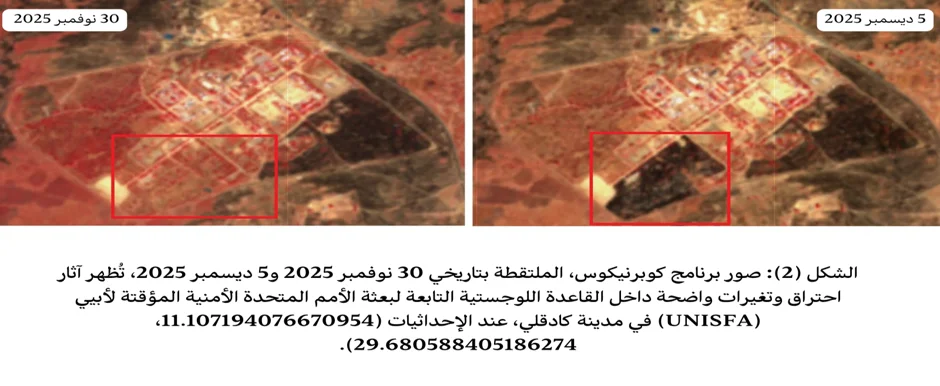
Through geolocation of publicly available visual material, the Dalil Team confirmed the attack on the logistics base of the United Nations Interim Security Force for Abyei (UNISFA). Satellite imagery also showed burn marks and material damage inside the base consistent with reports issued by the United Nations.
The Dalil Team’s analysis of satellite imagery showed damage at the Military Medical Hospital in (Kadugli) during the timeframe in which the attack was reported.
High-resolution satellite imagery revealed material damage at the headquarters of the General Intelligence Service and the Government Secretariat building in (Kadugli), confirming that both sites sustained damage during the period under investigation.
The Dalil Team was unable to independently verify responsibility for any of the attacks. Any attribution of responsibility in this report is based on statements or data issued by official entities or other organizations and does not represent an independent
conclusion reached by the Dalil Team.
Background of the Incidents
On 13 December 2025, the United Nations announced that the logistics base of the United Nations Interim Security Force for Abyei (UNISFA) in (Kadugli), the capital of (South Kordofan), had been attacked by drones.
According to UN statements, the attack killed six Bangladeshi peacekeepers and injured eight others, with some injuries described as serious.
It also caused extensive damage to the base’s facilities and affected its operational and logistical capacity.
The Sudanese Armed Forces stated that the Rapid Support Forces carried out the attack using drones, while the Rapid Support Forces denied responsibility.
The UN Secretary-General, António Guterres, condemned the attack, stating that targeting UN personnel and facilities may amount to a war crime under international law, and called for an investigation and accountability.
On 24 December 2025, (UNISFA) announced the evacuation of its logistics base in (Kadugli), following a security assessment which concluded that continuing operations at the site was no longer possible after the attack.
In a separate incident, the Sudan Doctors Network announced on 4 February 2026 that the Military Medical Hospital in (Kadugli) had been attacked by a drone, attributing responsibility to the Rapid Support Forces and the Sudan People’s Liberation Movement–North, Abdelaziz al-Hilu faction.
According to the Network, the attack killed one person and injured eight others, targeting one of the functioning medical facilities in the city at a time when approximately 50% of medical facilities had gone out of service due to shelling and siege.
On 8 February 2026, (Al Hadith) channel published images showing fire damage at several government facilities in (Kadugli), reporting that the attacks were carried out by drones and targeted the headquarters of the General Intelligence Service and several government and strategic facilities.
Geolocation Verification and Evidence Analysis
The Dalil Team conducted geolocation verification of the visual material related to the attack on the (UNISFA) logistics base.
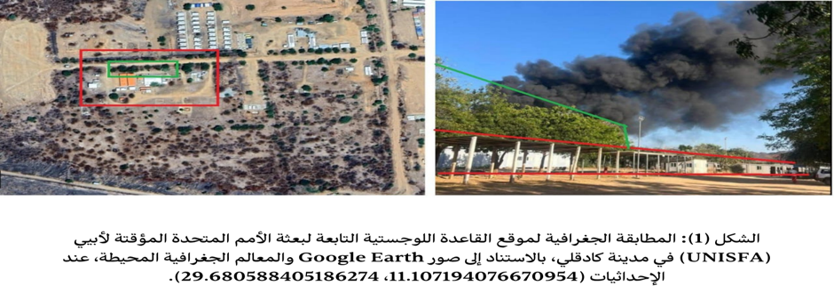
On 13 December 2025, a video was published showing smoke rising from inside the base after the attack. The Dalil Team identified the base’s location at the following coordinates: 11.107194076670954, 29.680588405186274
The Dalil Team relied on matching visible landmarks in the image with satellite imagery and (Google Earth) maps, confirming that the footage was filmed from outside the targeted base, as shown in Figure (1).
A comparison of (Copernicus) satellite images captured on 30 November 2026 and 5 December 2026 showed burn marks and clear changes inside the base, consistent with damage resulting from the attack, as shown in Figure (2).
Based on the available evidence, the Dalil Team was able to verify that the attack occurred and to identify its material effects on the base, while the available open-source material did not allow the team to independently determine the perpetrating party.
Regarding the Military Medical Hospital in (Kadugli), the Dalil Team was unable to find images or videos documenting the attack or its immediate aftermath.
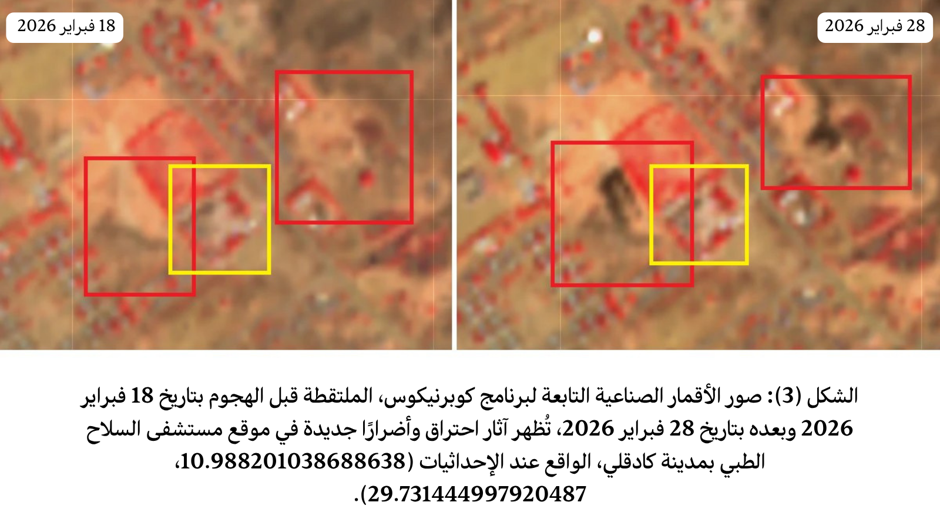
However, a comparison of (Copernicus) satellite images captured before the attack on 18 February 2026 and after it on 28 February 2026 showed burn marks and new damage at the site located at the following coordinates: 10.988201038688638, 29.731444997920487
These changes are temporally and geographically consistent with the published information regarding the attack, as shown in Figure (3).
As for the government facilities, the Dalil Team analyzed the images published by (Al Hadath), but could not conclusively match them to the targeted locations due to the limited visible landmarks.
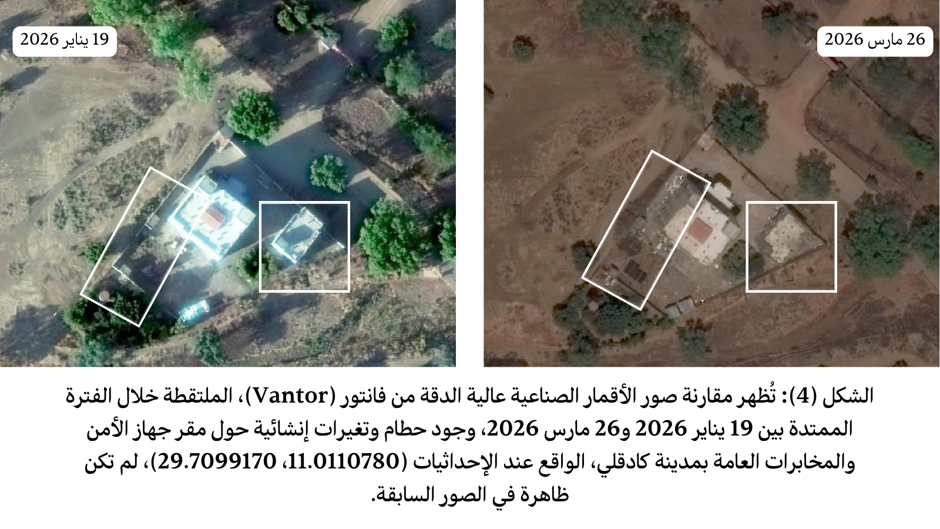
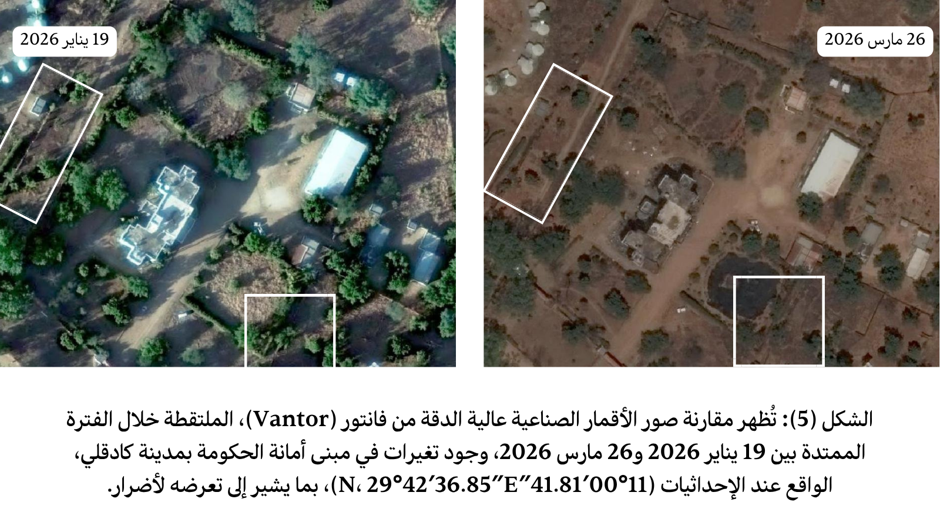
To strengthen the verification process, the Dalil Team relied on high-resolution satellite imagery from (Vantor), which showed material changes and damage at two main locations during the period from 19 January 2026 to 26 March 2026.
At the headquarters of the General Intelligence Service, located at: 11.0110780, 29.7099170
the image comparison showed debris and structural changes around the building that were not visible in earlier imagery, as shown in Figure (4).
Satellite imagery also showed similar changes at the Government Secretariat building in (Kadugli), located at: 11°00′41.81″N, 29°42′36.85″E
These changes indicate that the building sustained damage during the same period, as shown in Figure (5).
Given the absence of visual material directly linking the published images to these sites, the Dalil Team’s conclusion is limited to verifying that material damage occurred at the two buildings during the period under investigation, without being able to determine the cause of the damage or identify the responsible party.
Damage Analysis
The Dalil Team’s analysis indicates that the attack on the (UNISFA) logistics base left clear material effects inside the site, including burn marks and changes within the internal structure of the base.
These indicators are consistent with the damage reported by the United Nations regarding the impact on the base’s facilities and its operational and logistical capacity.
At the Military Medical Hospital in (Kadugli), satellite imagery showed burn marks and new damage at the site during the period in which the attack was reported.
Although no direct ground-level visual material was available, the changes observed in satellite imagery provide an objective indicator of material damage at the reported medical site.
Regarding the government facilities, the analysis of high-resolution (Vantor) imagery revealed material damage at the headquarters of the General Intelligence Service and the Government Secretariat building, including debris and structural changes around the buildings that were not visible in earlier imagery.
This confirms that both sites sustained damage during the period under investigation, while the available evidence does not allow the Dalil Team to independently determine the cause of the damage or the party responsible.
Evidence-Based Findings
The evidence analyzed by the Dalil Team confirms that an attack occurred on the (UNISFA) logistics base in (Kadugli), with burn marks and material damage visible inside the base.
The damage observed inside the (UNISFA) base is consistent with UN statements regarding the attack, the deaths and injuries of peacekeepers, and the impact on the base’s operational and logistical capacity.
Satellite imagery comparison indicates new damage at the Military Medical Hospital in (Kadugli) during the timeframe linked to the published report of the attack.
High-resolution satellite imagery confirms that the headquarters of the General Intelligence Service and the Government Secretariat building in (Kadugli) sustained material damage between 19 January 2026 and 26 March 2026.
The Dalil Team was unable to independently verify the party responsible for any of the attacks, and the available open-source evidence does not allow for conclusive attribution.
Any allegations regarding responsibility in this report remain attributed to the entities that issued them, including the United Nations, the Sudanese Armed Forces, the Rapid Support Forces, the Sudan Doctors Network, or media outlets, and do not represent an independent conclusion by the Dalil Team.
Legal Assessment
The attack on the (UNISFA) logistics base, in light of UN reports of deaths and injuries among peacekeepers and damage to UN facilities, raises serious concerns regarding the protection of UN personnel and facilities under international law.
The targeting of a functioning medical facility, if the circumstances of the attack are established, may raise concerns regarding potential violations of the special protection afforded to medical facilities, personnel, and patients under international humanitarian law.
The damage sustained by government facilities inside a populated city raises questions regarding compliance with the principles of distinction, proportionality, and the obligation to take necessary precautions during attacks.
The available evidence does not allow the Dalil Team to determine individual or institutional legal responsibility for these attacks, which requires further independent and expanded investigation.
Based on the evidence verified by the Dalil Team, the documented incidents raise serious legal concerns regarding the protection of UN, medical, and government facilities during the conflict, and call for effective investigation and accountability.
Conclusion
The pattern of attacks and damage documented by the Dalil Team in (Kadugli) reflects the expanding risks faced by UN, medical, and government facilities in conflict-affected areas. Open-source evidence, including visual material and satellite imagery, confirms material damage at multiple sites during the period under investigation.
While the Dalil Team was able to verify the locations of the damage and its general nature, the available evidence does not allow for independent attribution of responsibility.
Accordingly, this report is based on documenting verifiable facts, analyzing their legal and humanitarian implications, and calling for independent investigations to identify those responsible and ensure accountability.