Report Introduction
Since mid-April 2023, Sudan has witnessed a sharp escalation in armed conflict, leading to a widespread collapse of the security structure and the civilian state, followed by serious humanitarian and social repercussions. Among the most prominent of these repercussions is the phenomenon of recruiting civilians, especially children, by various parties to the conflict, whether official forces or irregular armed groups, which constitutes a grave violation of international humanitarian law and children's rights according to international standards.
The recruitment of children, women, and youth is a complex phenomenon linked to several interconnected factors, including economic collapse, the disintegration of state institutions, the expansion of security chaos, social pressures, and mobilizing discourse that seeks to recruit civilians under the slogans of protection and popular resistance. These conditions have led to the spread of multiple patterns of recruitment, including recruitment for community protection, economic recruitment, recruitment based on tribal and social affiliation, as well as voluntary recruitment under deception, reaching the most dangerous pattern: the recruitment of children to participate in combat operations or war-support tasks.
This report aims to document and review these patterns and their impact on civilians, with a focus on children, and to clarify the contexts that contributed to the emergence of this phenomenon, as well as to analyze the accompanying legal and humanitarian violations, to enable a deeper understanding of the current war's repercussions on Sudanese society and future generations. The report hopes to serve as a reference that can be relied upon in formulating policies for the protection of children and civilians, developing effective accountability mechanisms, and taking practical steps to reduce the phenomenon of illegal recruitment in Sudan.
Since the outbreak of armed conflict on April 15, 2023, Sudan has been experiencing one of its deepest historical crises—a crisis that has changed the social structure of the state, turned the relationships between individuals, society, and the state upside down, and opened the door to a phase whose repercussions are still unfolding day by day. With the sudden explosion of violence between the Sudanese Armed Forces and the Rapid Support Forces, the pillars of the modern state built over decades gradually collapsed, and the legal and institutional protection system that could have protected civilians, especially children and the most vulnerable groups, was torn apart. Against this backdrop of collapse, the phenomenon of recruitment has accelerated, its forms have multiplied, and it has transformed from scattered individual cases into a widespread national phenomenon covering various states and social environments, directly impacting the future of coming generations.
What distinguishes the current situation is that it is not merely a conventional war between two regular forces, but a total collapse that has allowed the spread of local groups, the formation of parallel authorities, and the transformation of civilians themselves into active parties to the conflict through various recruitment mechanisms. With the interruption of education, the absence of services, and the displacement of millions, children find themselves on the front lines of the shock, vulnerable to recruitment, exploitation, and psychological and physical risks from numerous parties, some official and some unofficial. This turbulent environment has created an unprecedented new context in Sudan's history, where children and adolescents are naturally present in military spaces within destroyed neighborhoods, makeshift camps, and villages living under daily threat.
As the war expands to new states and previously safe areas such as Al-Jazirah, Gedaref, and Kassala, indicators are increasing that society as a whole has entered a state of widespread recruitment—some under the banner of protecting land and honor, some under the banner of a collapsed economy, and some as a result of feverish mobilizing discourse through media and digital platforms.
Expansion of Collapse Manifestations and the Creation of Recruitment Environments
The impact of the conflict was not limited to the state's loss of military control over limited areas, but extended to the suspension of judicial, police, educational, health, and even banking institutions in large parts of the country. With the collapse of legal and regulatory frameworks, daily life became governed by rules set by the strongest, and local communities were forced to invent their own methods of protection and organization, opening the door to the formation of informal armed networks that would have remained marginal under other circumstances.
In the absence of the police, many small local conflicts turned into widespread armed clashes, villages became vulnerable to repeated looting, and the ability to protect markets, farms, and supply lines disappeared. In this context, groups ostensibly committed to protecting villages emerged but quickly transformed into semi-organized combat formations, especially in the states of Al-Jazirah, Sennar, and Kordofan. These groups, which began with simple tasks such as organizing night guards or escorting convoys, soon expanded into combat cells, as the growing security vacuum raised community expectations regarding their ability to confront attacks, leading them to evolve from civilian groups into armed parties seeking to strengthen their influence.
The collapse is not limited to the security sector. The sudden expansion of internal displacement led to the disintegration of family ties. Millions of displaced people found themselves in crowded camps or in the open without sources of income, leading to children and adolescents becoming connected to the street and to violence as a daily scene, and exposing them to intense military propaganda that presents an exaggerated image of power, belonging, and heroism. With the absence of schools, time became unlimited, and weapons and manifestations of militarization are present on every corner, making any child vulnerable to polarization within hours.
Recruitment for Community Protection
In villages and rural areas that were not equipped to deal with the security collapse, spontaneous local protection groups emerged, often composed of village youth, sometimes including children or adolescents aged 14 or 15. These groups began with simple attempts to defend homes and fields, but soon became part of the conflict itself. In the Wad al-Noura area of Al-Jazirah state, for example, the night guard committees established by civilians at the beginning of the war developed into armed mobilization groups receiving training and participating in military operations alongside regular forces or against other groups.
Psychological and social factors played a pivotal role in inflating this type of recruitment. Scenes of looting, assaults, and killings placed communities in a state of constant fear, and with the absence of the state, weapons became a logical option for villagers. The implicit joining of children and adolescents became part of the family's duties to protect the village, especially in societies where carrying a weapon is considered part of early manhood. Over time, these groups began to exercise wide powers, and the combat roles of adolescents became a reality in the absence of any legal deterrent or effective family oversight.
Economic Recruitment
Recruitment for economic reasons is most widespread in relatively safe areas, such as eastern Sudan, and is the most dangerous pattern because it is directly linked to economic collapse, unemployment, and food shortages. With rising prices of basic commodities and the collapse of traditional sources of income such as agriculture, trade, and daily labor, joining an armed group became a way to secure daily sustenance. The states of the Red Sea, Kassala, and Gedaref witnessed a large proportion of this type of recruitment, especially among families hosting displaced persons or suffering from the loss of their primary breadwinner.
Testimonies have shown that groups such as the Joint Forces opened the doors of their camps without clear controls, and that the economic factor is the biggest driver. Children and adolescents find in promises of financial income an opportunity to compensate for the absence of school and the migration or loss of fathers, while women find in this joining a means to support their families after losing husbands or being displaced away from livelihoods.
The privileges granted to the mobilized are often simple, but they become highly significant in conditions of extreme poverty. An identification card granting the right to treatment, a daily meal, a financial incentive of one hundred thousand Sudanese pounds, or even just a promise of obtaining a weapon that might bring social prestige—all are incentives that found fertile ground among the poor and fragmented families. However, the great danger lies in the fact that these privileges are unstable, and loyalties can change quickly, creating a generation of children and adolescents linked to weapons as a means of survival.
In areas like Khartoum North, the phenomenon is radically different, as recruitment there is based more on revenge or property protection than on economic motives. Despite the absence of financial compensation, recovering what was looted by the Rapid Support Forces formed a central motivation for youth and adolescents, opening the door to uncontrolled practices such as "shafshafa" (informal confiscation). This context reshapes the social mentality towards violence and creates a direct link between survival and the ability to exercise force, making children in those areas vulnerable to replicating dangerous behaviors in the future.
Recruitment Based on Tribal and Social Affiliation
In the states of Darfur and Kordofan, recruitment took on a deeply rooted tribal character, linked to what is known as "Al-Faza'a" (tribal mobilization call)—a social pressure that cannot be easily resisted. This deep social culture sees the response of children and youths to Al-Faza'a as part of protecting the group, making refusal to join almost impossible. Witnesses have mentioned that some communities in North and West Kordofan now view weapons as part of a child's social identity, and that children as young as 10 or 11 sometimes participate in guard duties or supply transport, placing them on a path of early militarization with deep psychological effects.
In Darfur, old tribal conflicts intertwine with the current war, making children vulnerable to double mobilization: first by armed groups, and second by the community itself. This recruitment transforms from a mere security phenomenon into a factor that reshapes the tribal structure, with effects extending into the future, as entire generations grow up on a culture of weapons and tribal defense, in the complete absence of a state culture.
Voluntary Recruitment Through Deception
Recruitment through media deception is one of the most widespread and impactful patterns, relying on an intensive mobilizing discourse broadcast through official and community media, in addition to digital platforms that have become the primary source of information for youth. This discourse often portrays war in heroic terms, uses vocabulary such as victory, dignity, and defense of the homeland, and targets groups that may be frustrated, hopeless, or living in difficult conditions within displacement areas.
It is observed that this type of recruitment exploits the nature of adolescence, characterized by a desire for belonging and identity-seeking, presenting an idealistic picture of heroism without revealing the harsh reality of combat. Testimonies from displacement areas in Al-Jazirah and Gedaref have shown that young people living in crowded camps are daily exposed to propaganda talking about the "duty of resistance," making them vulnerable to voluntary recruitment without realizing that those leading this discourse often remain far from the front lines.
Child Recruitment
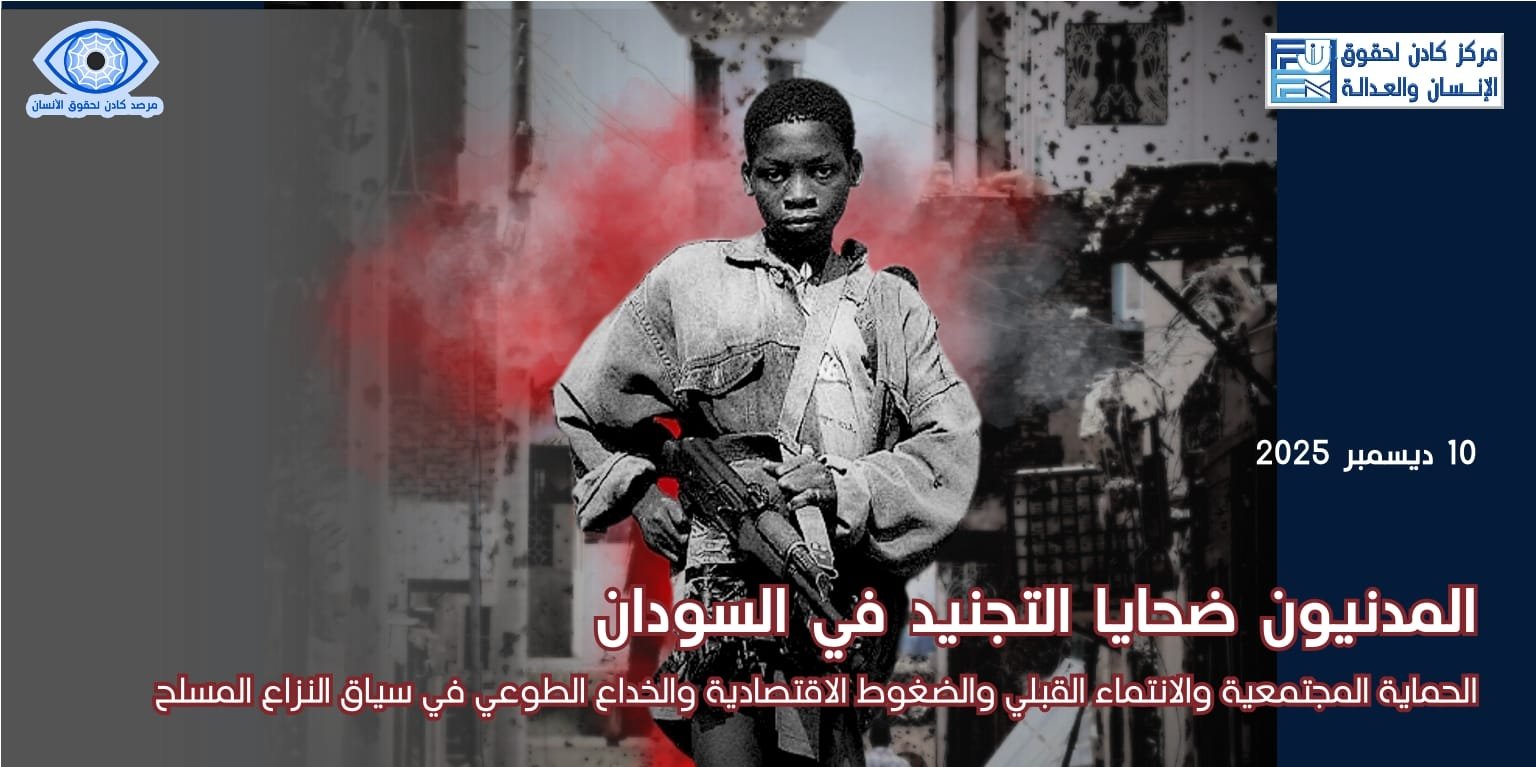
Child recruitment is the most dangerous product of the war in Sudan. A child whose physical or mental development is incomplete is thrust into a context requiring awareness and psychological balance they do not possess. Numerous testimonies show that children are initially exploited for small tasks such as delivering messages, monitoring roads, gathering information, or carrying ammunition, but over time they become front-line elements. Cases have been documented of children between the ages of 13 and 15 participating in direct battles in areas of Kordofan.
Recruited children experience severe trauma beyond their psychological capacity to endure, as they witness the killing of friends, sustain injuries, or participate in acts that no child in a normal situation could engage in. In displacement camps, children who have lost their families become easy targets, as they lack parental protection and suffer from psychological fragility that makes them accept joining any entity that offers them food or protection.
Testimonies indicate that the vast majority of children who have been recruited have been out of school for a long time due to the war, making their future return to normal life an almost impossible task without long-term psychological and social intervention.
Legal and Humanitarian Violations
Despite the clarity of international standards and national laws prohibiting the recruitment of children or the forced involvement of civilians, the reality of war in Sudan proves that these rules are no longer effectively applied. Child recruitment is classified as one of the six grave violations against children in armed conflict according to the United Nations, and is often linked to other violations such as sexual violence, deprivation of education, and economic exploitation. It is a crime that demands accountability, not only at the level of individuals who recruit children, but at the level of an entire system that allows the normalization of the presence of weapons in a child's life.
Recruitment Camps
Monitoring operations indicate the existence of official and semi-official recruitment camps. Some are run by the armed forces, such as the two women's camps in South Port Sudan, where recruits undergo six months of training, after which they receive an identification card and a weapon. The existence of these camps reflects the level of fragility that society has reached, as women have become part of the widespread military mobilization cycle, indicating that recruitment is no longer a phenomenon limited to men and children alone, but includes all groups.
In other areas, such as neighborhoods in Khartoum North, makeshift camps appear inside homes, schools, or service centers, used to train mobilized individuals hastily before sending them to focal points. These camps operate outside any legal or supervisory framework and place civilians in direct confrontation with violence without qualification or protection.
All evidence shows that the phenomenon of recruiting civilians, including children, is not merely a reflection of the war, but one of the most prominent components of its continuation. Children who carry weapons today are subjected to psychological and social trauma that will create a fragile generation difficult to integrate into civilian life later. Families that allow their children to join due to poverty will find themselves in the future facing sons who have lost confidence in school and society and become more inclined towards violence. Communities that rely on Al-Faza'a or self-protection will face long years of internal divisions.
Today, Sudan is not merely facing a military tragedy, but an existential crisis affecting the social, moral, and legal foundations of the state. Addressing this crisis requires long-term efforts, including rebuilding education, psychological rehabilitation of children, holding those involved in recruitment accountable, and rebuilding community trust in the state.