Key Findings
Incidents documented and analysed by the Dalil Team reveal a series of attacks and damage affecting critical civilian infrastructure in (El Obeid) between January and June 2026, including electricity, fuel and medical facilities.
Satellite imagery analysis identified changes and signs of damage at several locations under investigation. In multiple incidents, the periods in which these changes appeared corresponded with reported attack dates, providing independent supporting evidence alongside open-source material and local reporting.
The effects extended beyond direct physical damage. Disruption to the electricity station resulted in power outages affecting parts of the city and disrupted health services, including emergency departments and dialysis centres, while several water stations also stopped operating.
Electricity outages further aggravated the water crisis in (El Obeid), as most groundwater pumps and principal pumping stations ceased operating. Residents were forced to rely increasingly on water distribution points and tankers, while the cost of obtaining water rose and alternative sources were unable to meet the city’s needs.
Attacks affecting fuel infrastructure increased pressure on fuel supplies. According to the available information, black-market prices rose to between SDG 150,000 and 160,000 per gallon of petrol, while diesel reportedly cost between SDG 75,000 and 90,000 per gallon.
The reported attack on the British Dispensary had a direct impact on civilians and healthcare workers. According to the Sudan Doctors Network, 12 people were injured, including five medical personnel, while several sections of the facility sustained damage.
These incidents occurred amid a deteriorating humanitarian situation and large-scale displacement, increasing the dependence of residents and displaced people on essential services and magnifying the humanitarian consequences of disruptions to electricity, water, fuel and healthcare.
The attacks coincided with increasing military mobilisation around (El Obeid). Against this backdrop, 21 states at the Human Rights Council warned of the potential expansion of military operations and the resulting risks to approximately half a million civilians in and around the city.
These warnings overlap with concerns raised by humanitarian and human rights organisations regarding the safety of civilians and displaced populations and continuing damage to civilian infrastructure, suggesting that further escalation could deepen the crisis in basic services, displacement and humanitarian needs.
Taken together, the evidence indicates that damage to individual critical facilities generated cascading effects across civilian life, with disruptions to electricity and fuel affecting water supply, healthcare and other essential services.
Background
(El Obeid), the capital of (North Kordofan) State, experienced a series of attacks affecting infrastructure associated with essential services during the first half of 2026, at a time when the city was already facing increasing humanitarian pressure as a result of conflict, displacement and deteriorating public services.
The incidents analysed by the Dalil Team include the (Matthew) Fuel Station, the (El Obeid) electricity substation—which was reportedly attacked on multiple occasions during the period under investigation—and the British Dispensary.
The Team analysed open-source material, including video footage, photographs and published reports, alongside geolocation and satellite imagery available through Google Earth, Copernicus and Planet.
These incidents are particularly significant because of the interdependence of basic-service sectors within the city. Disruption to electricity, for example, affects not only power supply but also the operation of water stations, pumps and healthcare facilities. Fuel shortages can likewise affect transport, generators and other essential services.
(Matthew) Fuel Station
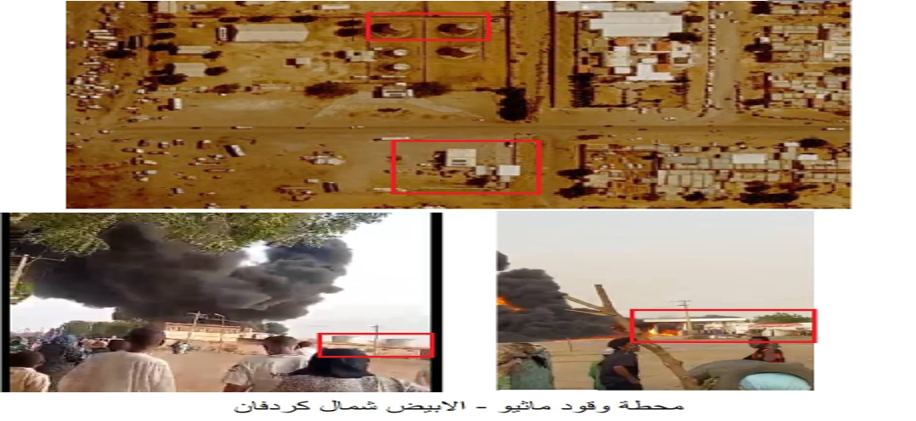
On 6 June 2026, the Darfur Victims Advocacy Organisation published video footage showing thick columns of smoke following what it described as a drone attack by the Rapid Support Forces on the (Matthew) Fuel Station at approximately 5:00 p.m.
The station is located near the Police House in (El Obeid), at: 13.19111466238725, 30.22594255075918
According to published information, the drone struck areas associated with fuel supply and the station’s main pumps, causing a major fire and producing dense clouds of smoke.
Geolocation
The Dalil Team geolocated the published footage using buildings, roads and other fixed features visible in the recording.
The comparison showed correspondence between the visual features in the video and the geographic location of the (Matthew) Fuel Station, supporting identification of the incident location at the coordinates above.
Damage Analysis
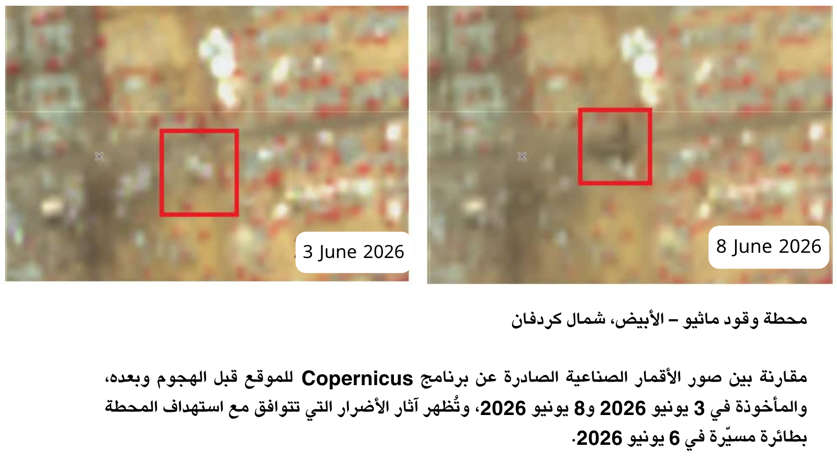
The Dalil Team compared(Copernicus) satellite imagery of the site captured on 3 June and 8 June 2026.
The comparison showed physical changes and signs of damage appearing during the period between the two images, which encompasses the reported attack date of 6 June.
This temporal correspondence provides independent supporting evidence that physical changes occurred at the location during the period in which the attack was reported.
Following attacks affecting fuel stations and fuel transport, black-market fuel prices reportedly increased, with petrol reaching between SDG 150,000 and 160,000 per gallon and diesel between SDG 75,000 and 90,000 per gallon.
(El Obeid) Electricity Substation
The (El Obeid) electricity substation was reportedly attacked several times during the first half of 2026, according to open sources reviewed by the Dalil Team.
18 June 2026 Attack
On 18 June 2026, the Dar Hamar Emergency Room reported on Facebook that the electricity substation in (El Obeid) had been attacked.
The following day, the Sudan Doctors Network reported that the attack had caused a power outage and affected a number of medical facilities, resulting in emergency departments and dialysis centres going out of service and causing several water stations to stop operating.
The Network warned that more than one million residents and displaced people inside the city had been affected by the disruption to essential services.
Also on 19 June, Emergency Lawyers issued a statement condemning the attack on the electricity substation, alongside drone attacks on roads, fuel stations and fuel tankers.
The group warned that the continuation of such attacks, combined with military mobilisation outside the city and mobilisation within it, posed an imminent threat to civilians, including displaced people.
Impact of the Electricity Outage on Water Supply
According to published information, the power outage caused most groundwater pumps and principal pumping stations to stop operating. These facilities had previously supplied approximately 8,000 cubic metres of water per day to the city.
As a result, long daily queues formed at water distribution points and tankers, including women, children and older persons seeking water.
The price of a barrel of water reportedly rose to approximately SDG 25,000, while alternative supplies were limited to a number of solar-powered wells that could meet only a small proportion of the population’s needs.
Planet Satellite Analysis
The Dalil Team analysed high-resolution Planet satellite imagery of the substation at:
13.136749171750505, 30.283286748855815
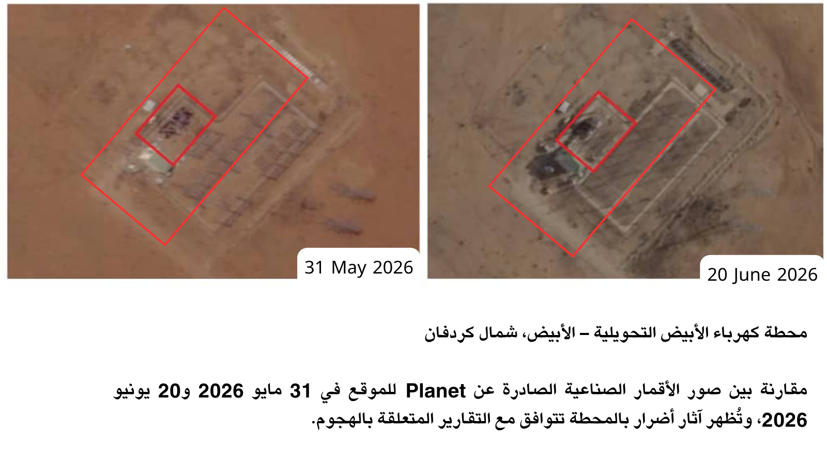
A comparison between imagery captured on 31 May 2026 and 20 June 2026 showed visible signs of damage inside the facility.
Additional imagery captured during June also showed that the damage remained visible at the site.
Copernicus Satellite Analysis
The Dalil Team additionally compared Copernicus satellite imagery of the site at:
13.136977977522811, 30.283101526972217
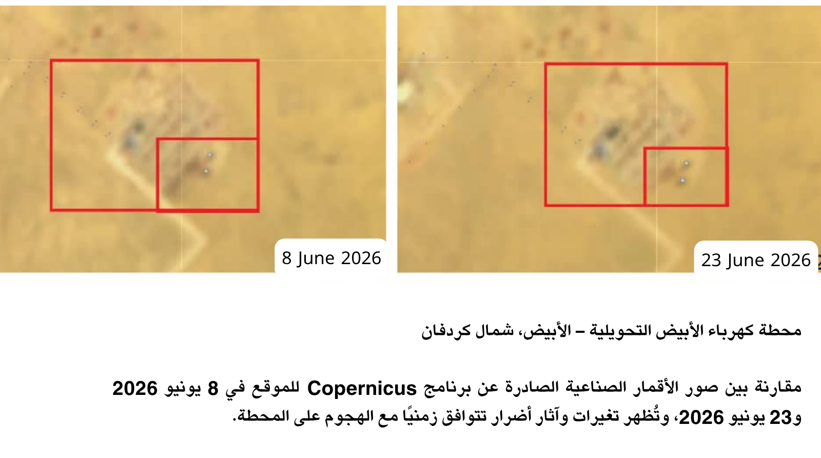
A comparison between images captured on 8 June and 23 June 2026 showed physical changes at the location that appeared during a period encompassing the reported 18 June attack.
The temporal correspondence between the observed changes and the reported incident provides supporting evidence that the facility sustained damage during that period.
Previous Attacks on the Electricity Station
The June 2026 incident was not the first reported attack affecting the electricity facility in (El Obeid).
January 2026 Attack
On 4 January 2026, Radio Dabanga reported that the Rapid Support Forces had launched a drone attack on the electricity generation facility in (El Obeid), alongside another attack on (Kenana) Airport in (White Nile) State.
According to a statement by the Sudan Electricity Coordination Media Council, the attack resulted in direct hits on the machinery building, causing a fire, a complete electricity outage and the facility going out of service.
The statement further reported that civil defence teams began extinguishing the fire and assessing the damage in preparation for repairs and restoration of service.
The Dalil Team reviewed Copernicus imagery of the location from 10 December and 15 December 2025, which showed changes and signs of damage at the facility.
However, both images predate the reported attack of 4 January 2026. They therefore cannot, on their own, be used to establish damage resulting from the January attack or link the observed damage to that incident temporally.
The published reporting concerning the 4 January incident must consequently be treated separately unless directly comparable satellite imagery from before and after the reported attack becomes available.
3 March 2026 Attack
On 3 March 2026, Ultra Sudan reported that the Rapid Support Forces had again targeted the (El Obeid) electricity substation south of the city using drones, causing a power outage as a result of damage to the facility.
The Dalil Team compared Copernicus satellite imagery captured on 28 February and 5 March 2026.
The comparison showed changes and signs of damage appearing during a period encompassing the reported attack date of 3 March, providing independent temporal evidence consistent with published reporting about the incident.
British Dispensary – El Obeid
On 3 March 2026, the Sudan Doctors Network reported that the Rapid Support Forces had targeted the British Dispensary in (El Obeid).
According to the Network, the attack injured 12 people, including five healthcare workers who were performing their duties inside the facility.
Some of the injuries were reported to be serious.
Images circulated on X also showed extensive damage affecting the surgical and dental departments and inpatient wards, as well as injuries to members of the medical staff.
Evidence Analysis
The Dalil Team analysed Planet satellite imagery of the dispensary at:
13.1822489, 30.2207718
A comparison between imagery captured on 20 April and 8 May 2026 showed visible signs of damage at the facility.
However, both images were captured more than a month after the reported attack of 3 March.
The imagery can therefore establish that damage was present at the facility during the later period, but it cannot, on its own, determine when the damage occurred or conclusively attribute it to the reported 3 March attack.
Images and videos published following the incident, together with information issued by the Sudan Doctors Network, remain separate sources of evidence concerning the attack and its reported consequences.
Cascading Effects on Essential Services
The incidents analysed by the Dalil Team show that the consequences of damage to individual facilities extended beyond the locations directly affected.
In the electricity sector, disruption to the (El Obeid) substation contributed to power outages affecting healthcare facilities, water stations and groundwater pumps.
In the water sector, the shutdown of pumps and pumping stations reduced available supply and forced residents to rely increasingly on distribution points, water tankers and alternative wells, while water prices increased.
In the fuel sector, attacks affecting fuel stations and transport coincided with substantial increases in the black-market prices of petrol and diesel, adding further pressure to transport, generators and other fuel-dependent services.
The reported attack on the British Dispensary illustrates the direct consequences that attacks on healthcare facilities can have for both medical personnel and the services provided to civilians.
Disruption to a single component of an interconnected infrastructure network can therefore affect multiple sectors and amplify humanitarian consequences for residents and displaced populations.
Humanitarian and Military Context
These incidents occurred amid increasing military mobilisation and conflict-related activity in and around (El Obeid).
In this context, 21 states at the Human Rights Council warned of the possibility of an expansion of military operations around the city and the direct risks this could pose to approximately half a million civilians in (El Obeid) and surrounding areas.
These warnings overlap with concerns expressed by humanitarian and human rights organisations regarding the protection of civilians and displaced people and continuing damage to civilian infrastructure.
Disruptions to electricity, water, fuel and healthcare further increase civilian vulnerability in such a context, particularly among displaced populations and those most dependent on public services and humanitarian assistance.
Evidence-Based Findings
The Dalil Team geolocated footage documenting the fire at the (Matthew) Fuel Station, while Copernicus imagery showed changes and damage at the location during a period encompassing the reported 6 June 2026 attack.
Planet and Copernicus imagery showed changes and damage at the (El Obeid) electricity substation during June 2026, with the period of change corresponding to the reported 18 June attack.
A comparison of Copernicus imagery from 28 February and 5 March 2026 showed changes at the electricity station during a period encompassing the reported 3 March attack.
The comparison of imagery from 10 and 15 December 2025 cannot establish damage caused by the reported 4 January 2026 attack because both images predate the incident.
Medical sources reported that the electricity outage following the attack on the substation disrupted emergency departments, dialysis centres and water stations.
Published information indicates that the shutdown of pumps and pumping stations exacerbated the water crisis and increased the cost of obtaining water.
Open sources document a reported attack on the British Dispensary on 3 March 2026 that, according to the Sudan Doctors Network, injured 12 people, including five healthcare workers.
Planet imagery confirms that damage was present at the British Dispensary during April and May 2026, but cannot independently establish when that damage occurred or conclusively link it to the reported 3 March attack.
Taken together, the incidents demonstrate cascading consequences from disruptions affecting electricity, fuel and medical facilities across water supply, healthcare and other essential services.
Legal Assessment
Electricity installations, fuel facilities, medical facilities and other civilian infrastructure are, as a general rule, civilian objects protected under international humanitarian law unless and for such time as they become military objectives under the applicable legal criteria.
Medical units and facilities benefit from specific protection under international humanitarian law because of their role in treating the sick and wounded and protecting life. Any attack affecting such facilities is of particular legal concern when it causes injury to patients or healthcare personnel or disrupts the provision of medical care.
Damage to electricity, water and fuel infrastructure can also produce consequences extending well beyond the physical site when it disrupts services indispensable to the civilian population.
The incidents examined in this investigation illustrate this interdependence: electricity disruption was associated with the shutdown of healthcare services, water stations and pumps, while damage affecting fuel infrastructure added pressure to services dependent on transport and energy.
International humanitarian law requires parties to a conflict to distinguish between military objectives and civilian objects and to take feasible precautions to avoid or minimise harm to civilians and civilian infrastructure.
Determining legal responsibility for any individual incident, however, requires evidence concerning the nature and use of the facility at the time of the attack, the means and methods employed, the intended target, the identity of the actor responsible, precautions taken and the surrounding military circumstances.
The open-source evidence available for all incidents examined in this investigation is not, by itself, sufficient to reach a final determination of individual or criminal responsibility for each attack.
Conclusion
Evidence collected and analysed by the Dalil Team documents a series of incidents affecting critical infrastructure in (El Obeid) during the first half of 2026, including electricity, fuel and healthcare facilities.
In several cases, video analysis and satellite imagery enabled the Team to identify locations and detect physical changes appearing during periods corresponding with reported attack dates.
The broader consequences, however, extended beyond the affected facilities themselves.
Electricity disruption affected water supply and healthcare; pressure on fuel supplies increased economic and operational burdens; and damage to the British Dispensary directly affected a medical facility and healthcare workers.
These interconnected impacts demonstrate the vulnerability of essential-service networks in a city hosting large numbers of residents and displaced people while simultaneously facing increasing military activity around it.
The evidence also underscores the importance of distinguishing between establishing that damage occurred and determining responsibility for that damage. In several incidents, the Dalil Team can establish the location, physical changes and approximate timing, while attribution to a specific actor and any determination of legal responsibility require additional evidence beyond what is currently available through open sources.