Key Findings
The Dalil Team verified that the video was filmed in front of the Zakia Awad Sati Women’s Dormitory, adjacent to the Soba West Police Station, in the Soba South area of Khartoum State.This determination was reached by matching the visual features appearing in the footage with satellite imagery and geographic reference material.
The footage documents the mass arrest of 35 civilians, including seven women and 28 men. They were made to sit on the ground in an open area beside a road, with their faces covered and the women separated from the men, while they were surrounded by members of an armed force wearing black shirts bearing a uniform emblem.
The speaker in the footage identified the force carrying out the operation as belonging to the Security Cell in Khartoum State. He stated that raids had been conducted in the neighbourhoods of Soba West, Soba Al-Hilla and Soba Al-Aradi on 19 July 2026. He also announced the arrest of the detainees and accused them of collaborating with the Rapid Support Forces.
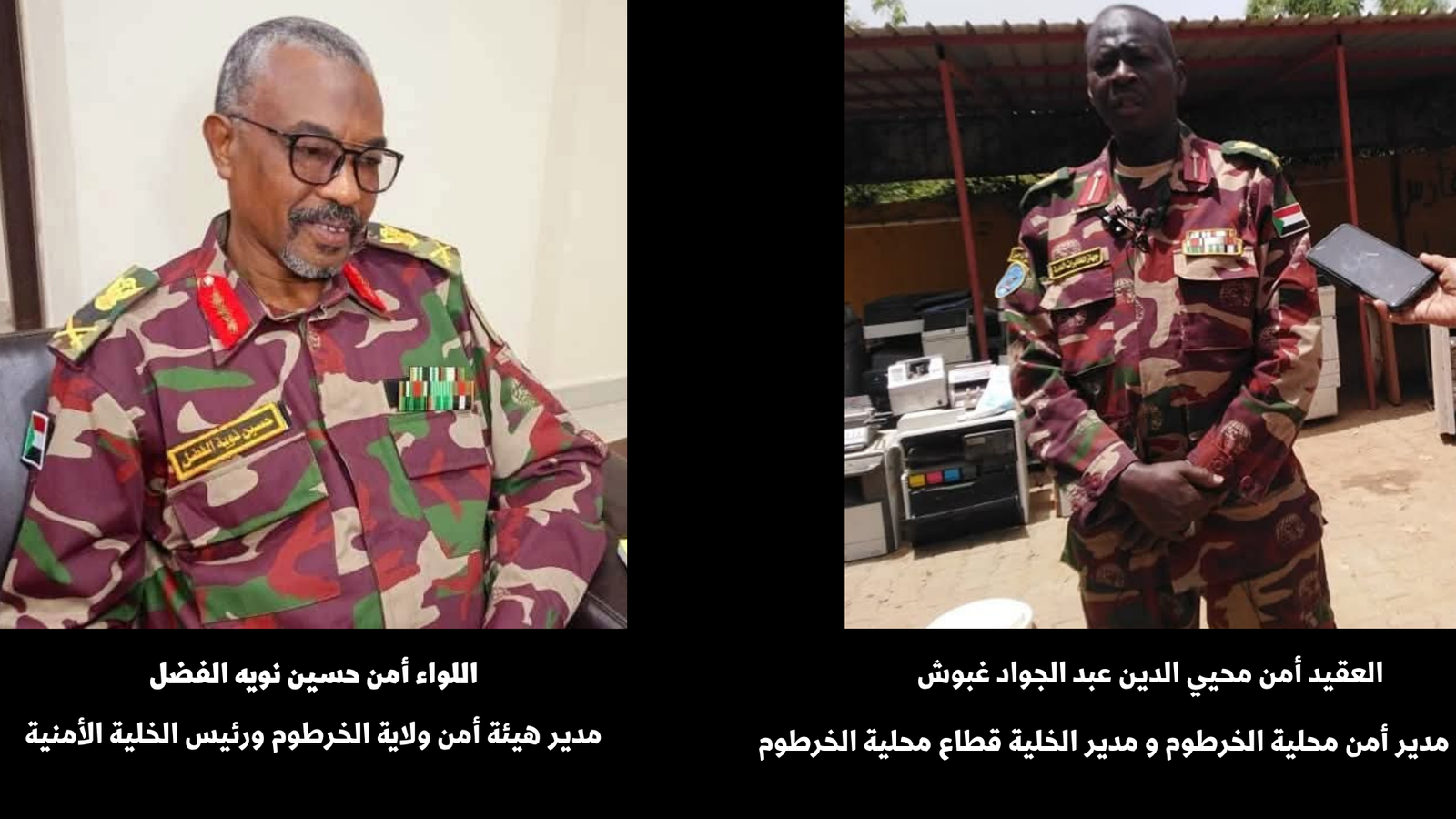
Open-source research identified names corresponding to those mentioned in the footage: Major General Hussein Nuwaya Al-Fadl, Director of the Khartoum State Security Authority and Head of the Security Cell, and Colonel Muhi Al-Din Abdel Jawad Ghaboush, Director of Security for Khartoum Locality and Director of the Security Cell for the Khartoum Locality Sector.
The investigation established that the Security Cell was created under Emergency Order No. 2, issued by the Governor of Khartoum State on 2 May 2024. It operates under the supervision of the State Security Affairs Coordination Committee and has been granted broad security and executive powers under the Emergency Order.
The footage indicates that the Security Cell exercised powers relating to arrest, the public announcement of accusations, the seizure of property and declarations concerning its return to its owners. These actions raise questions regarding the legal basis for exercising such powers, the limits of the Cell’s mandate and its relationship with the justice authorities.
The footage contains indicators of possible violations of several fundamental safeguards, including the presumption of innocence, the right to human dignity and privacy, and guarantees relating to arrest, detention and a fair trial. These concerns arise from the public display of the detainees and the attribution of accusations to them before they were brought before the competent judicial authorities.
The incident is of particular significance in light of previous human rights reports documenting violations attributed to the Security Cell in Khartoum State. This underscores the need for greater transparency, legal and judicial oversight of its activities, and accountability for any violations committed in the course of carrying out its functions.
Visual and Audio Description
A video published on Facebook on 24 July 2026 shows a mass arrest operation carried out by an armed force.
The footage shows at least 35 civilians, including seven women and 28 men, seated on the ground in an open area beside a road, with their faces covered.
Approximately 20-armed personnel carrying Kalashnikov rifles surround them. The footage also shows that the women were separated from the men during their detention.
All members of the force are wearing black shirts bearing a yellow emblem. Some are also wearing military trousers or other parts of military uniform, as well as military boots.
A four-wheel-drive military vehicle carrying several members of the force is also visible.
The footage further shows two vehicles loaded with property.
The first is a pickup truck carrying several air-conditioning units. The second is a lorry loaded with various items, inside which several individuals can be seen arranging the property.
In the audio, the speaker identifies the force as belonging to the Security Cell in Khartoum State.
He states that, on 19 July, the force conducted raids targeting what he described as “militia hideouts and collaborators” in the neighbourhoods of Soba West, Soba Al-Hilla and Soba Al-Aradi, in the Soba area south of Khartoum.
He adds that the operation resulted, according to his account, in the arrest of 35 people whom he described as “collaborators”, as well as the seizure of vehicles loaded with property that he claimed belonged to civilians.
He further pledged that the property would be returned to its owners.
The speaker also states that the Security Cell operates under the leadership of “Major General Security Officer H” and “Colonel Security Officer Jeem Ghaboush”, and asserts that the Security Cell “will not allow any collaborator to live among citizens”.
Geolocation
The Dalil Team analysed the visual features appearing in the video, including the buildings, roads and surrounding elements at the filming location.
The Team was able to identify the filming location at the following coordinates: 15°30'13.64"N, 32°37'41.89"E.
The analysis established that the footage was filmed in front of the Zakia Awad Sati Women’s Dormitory, adjacent to the Soba West Police Station, in the Soba South area of Khartoum State, Sudan (see Figure 1).
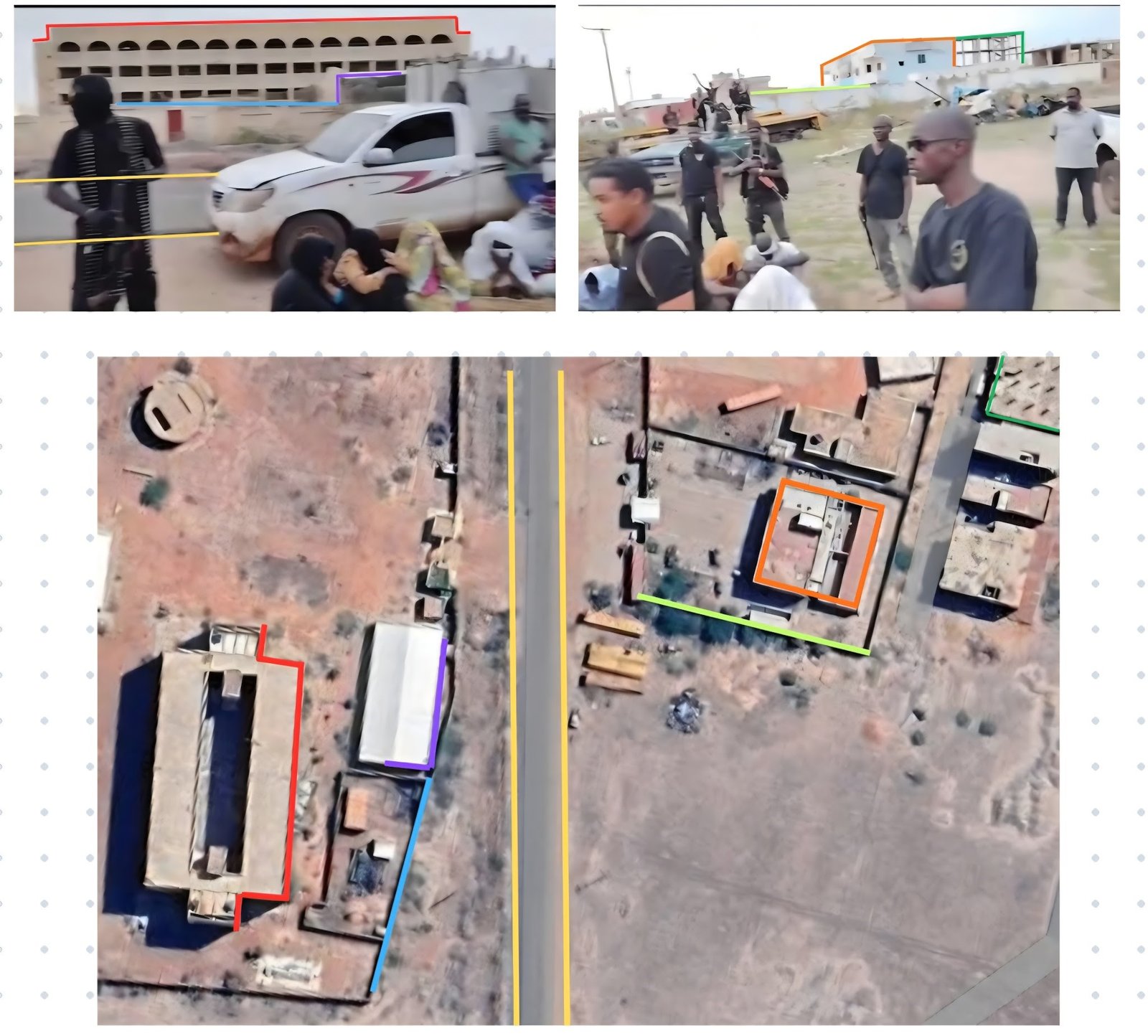
The geolocation process relied on satellite imagery from Google Earth dated 28 February 2025. The imagery showed correspondence between the fixed features visible in the video—including buildings, roads and surrounding urban elements—and the geographic reference imagery, supporting the accuracy of the identified filming location.
Identity Verification
The Dalil Team conducted open-source research to verify the identities of the individuals whose names were mentioned by the speaker in the recorded footage.
The research identified Major General Hussein Nuwaya Al-Fadl, who serves as Director of the Khartoum State Security Authority, according to a report published by the Khartoum Radio and Television Authority on 2 September 2025.
The research also indicated that he serves as Head of the Security Cell in Khartoum State, according to a report published by Al-Tabiya newspaper on 22 August 2024. This is consistent with the speaker’s reference to him as “Major General Security Officer H”.
The Team also identified Colonel Muhi Al-Din Abdel Jawad Ghaboush, Director of Security for Khartoum Locality and Director of the Security Cell for the Khartoum Locality Sector. Zahil News referred to him in a report published on 3 April 2025 as Acting Director of the General Intelligence Service in Khartoum Locality.
This is consistent with the reference in the footage to “Colonel Security Officer Jeem Ghaboush”.
The Dalil Team’s verification process relied on a review of open-source material, including publicly available photographs, videos and posts showing both individuals participating in events and activities connected to the Security Cell in Khartoum State.
This material supports the correspondence between the names mentioned in the footage and the identities of the two individuals (see Figure 2).
Background
On 2 May 2024, the Governor of Khartoum State issued Emergency Order No. 2 establishing the Security Cell in Khartoum State.
The order was based on the declaration of a state of emergency and a decision of the State Security Affairs Coordination Committee and entered into force on the date of its issuance.
According to the text of the decision published through the official spokesperson’s platform of the Government of Sudan, the Security Cell was assigned a number of functions.
These included collecting, analysing, classifying and acting upon information; operating as an early-warning mechanism for the other regular forces; focusing on urgent intelligence and security information representing an imminent threat; monitoring what the decision described as “sleeper cells”; and investigating and monitoring suspected individuals, locations and activities.
The decision also granted the Security Cell powers that include searching and raiding locations where hostile activity is confirmed; conducting joint interrogations of arrested persons; referring cases requiring lengthy, conventional security work to the competent regular agencies; carrying out specialised security campaigns in coordination with the regular forces; arresting habitual offenders and reducing crime; and performing any additional tasks assigned to it. The decision further stipulated that the Security Cell would operate under the supervision of the Higher Committee for Security and Operational Coordination and submit periodic reports to it.
Among the examples listed within the Cell’s mandate, the decision referred to the “movement of community support bases from areas where the enemy is present to areas controlled by the Armed Forces”.
This wording prompted criticism from human rights organisations over concerns that it could be used as a basis for measures targeting civilians on regional or ethnic grounds.
In this context, local and international human rights organisations have documented violations attributed to the Security Cell in Khartoum State.
These have included allegations of arbitrary arrest, enforced disappearance, extrajudicial killing and the filing of criminal cases against civilians accused of collaborating with the Rapid Support Forces.
Depending on the legal characterisation of the offence, such accusations may carry penalties under existing Sudanese legislation ranging from fines and life imprisonment to the death penalty.
Those organisations have also called on the Sudanese authorities to halt violations, ensure compliance with fair trial standards, refrain from targeting individuals on ethnic or geographic grounds, and subject the activities of the Security Cell to legal and judicial oversight.
The legal framework under which the Security Cell was created indicates that it derives its powers from emergency orders, granting it exceptional authority in the performance of its functions.
At the same time, publicly available information concerning its organisational structure, membership, premises and oversight mechanisms remains limited. This raises human rights concerns regarding the level of transparency and accountability governing the activities of the body.
Chain of Responsibility and Organisational Structure
Official documents, particularly Emergency Order No. 2 issued by the Governor of Khartoum State on 2 May 2024, indicate that the Security Cell operates within a tiered security structure connecting political and security authorities at the federal and state levels and defining lines of supervision and responsibility.
First: Federal Level
At the top of the hierarchy is the Chairperson of the Transitional Sovereignty Council and Commander-in-Chief of the Armed Forces, as the authority under which the state of emergency was declared and upon which the Governor of Khartoum relied in issuing Emergency Order No. 2 establishing the Security Cell.
Second: Governor of Khartoum State
The Governor of Khartoum State is the executive authority that issued the Emergency Order establishing the Security Cell. The decision also authorised the Governor to provide the necessary funding for its operations, allocate premises to it and establish branches in the state’s localities whenever necessary.
Third: Khartoum State Security Affairs Coordination Committee
The Higher Committee for Security and Operational Coordination
The State Security Affairs Coordination Committee is the body responsible for supervising the activities of the Security Cell, receiving its periodic reports and coordinating security work among the regular agencies.
The Committee consists of:
The Governor of Khartoum State, as Chair.
The Khartoum Military Area Command, representing the Sudanese Armed Forces.
The Director of Khartoum State Police and representatives of specialised police departments.
The Director of the Khartoum State Security Authority, representing the General Intelligence Service.
A representative of the Public Prosecution in the state.
The Secretary-General of the State Government, serving as rapporteur and member.
The Committee coordinates joint security operations among the Sudanese Armed Forces, the police and the General Intelligence Service. It also supervises the security mechanisms operating in the state, including the Security Cell.
Fourth: Khartoum State Security Authority
The State Security Authority is one of the permanent security agencies affiliated with the General Intelligence Service. It exercises security supervision at the state level and serves as the link between the State Security Affairs Coordination Committee and the Security Cell.
Fifth: The Security Cell in Khartoum State
The Security Cell is the executive mechanism created under Emergency Order No. 2. It was assigned functions including collecting and analysing information, operating as an early-warning body, monitoring what the decision described as sleeper cells, conducting investigations and surveillance, searching and raiding locations, jointly interrogating arrested persons, referring cases to the competent authorities, implementing joint security campaigns, arresting habitual offenders and performing any additional tasks assigned to it.
The wording of the decision indicates that the Cell operates through a joint leadership structure comprising officers from the General Intelligence Service, Military Intelligence and the police, in addition to teams and field units responsible for carrying out security operations on the ground.
Accordingly, the organisational hierarchy of the Security Cell may be described as follows:
Chairperson of the Sovereignty Council and Commander-in-Chief of the Armed Forces → Governor of Khartoum State → State Security Affairs Coordination Committee → Khartoum State Security Authority → Security Cell → Teams and field units.
At another level, concerning the direct supervision of the Cell’s activities, the operational chain may be described as follows:
State Security Affairs Coordination Committee → Khartoum State Security Authority → Security Cell.
The State Security Affairs Coordination Committee and the Khartoum State Security Authority are permanent bodies for which publicly available information exists concerning their composition, functions and leadership.
By contrast, insufficient official information is available regarding the Security Cell’s internal structure, membership, premises, procedures for selecting its personnel or accountability mechanisms. This makes it less transparent than other security institutions.
From a legal perspective, the original mandate of the General Intelligence Service under Sudanese law is limited to collecting and analysing information and submitting it to the competent authorities. Arrest, search and detention procedures are subject to the law and must be carried out by legally authorised bodies. However, Emergency Order No.
2 granted the Security Cell broad executive powers, including raids, searches, joint interrogation and the implementation of security campaigns.
This expanded the scope of its exceptional authority under the state of emergency beyond the ordinary powers assigned to the General Intelligence Service.
Legal Assessment of the Alleged Violations
The recorded footage raises a number of serious indicators of possible violations of fundamental principles and safeguards protected under Sudanese law and international human rights law, particularly those relating to the rights of arrested persons and guarantees of a fair trial.
The footage shows the security force displaying the detainees in front of the camera and describing them as “collaborators” with the Rapid Support Forces.
It also shows the speaker announcing their arrest as individuals who had committed criminal acts before they had been referred to the Public Prosecution or brought before a competent judicial authority.
Such conduct may undermine the presumption of innocence and subject the detainees, in practice, to a media trial before any judicial proceedings have taken place. This could affect their rights to a defence and a fair trial.
The footage also shows the detainees seated in a public place beside the road, with the women separated from the men, their faces covered and armed personnel surrounding them. They were then filmed, and the recording was published on social media.
These practices raise concerns regarding respect for the detainees’ human dignity, the prohibition of degrading or humiliating treatment and their right to privacy, particularly as no judicial judgments had been issued against them at the time of filming.
The footage further raises concerns regarding the exercise of criminal law-enforcement powers.
The speaker announced that vehicles and property allegedly belonging to civilians had been seized and pledged that they would be returned to their owners.
Verifying ownership of seized property, preserving it and determining how it is to be handled are procedures that are ordinarily subject to the supervision of investigative and justice authorities under the legal rules governing evidence collection and the disposal of exhibits. This raises questions regarding the legal basis upon which the Security Cell exercised such powers.
The footage also raises questions concerning the legal safeguards accompanying arrest and detention procedures.
It provides no indication that arrest warrants had been issued, that the Public Prosecution was supervising the operation, where the arrested persons were subsequently detained, or whether they were allowed to contact their families or lawyers.
These are all fundamental safeguards intended to protect individuals from arbitrary detention, enforced disappearance and ill-treatment.
The significance of the incident is heightened by the broader context documented by human rights organisations, which includes repeated allegations that security cells in areas controlled by the Sudanese Armed Forces have carried out arrest and detention operations against civilians suspected of collaborating with the Rapid Support Forces.
Additional allegations have concerned arbitrary arrest, enforced disappearance and extrajudicial killing.
In this context, there is a need to clarify the legal basis upon which these formations operate, the limits of their jurisdiction and the extent to which they are subject to supervision by the Public Prosecution and judicial oversight, in order to ensure respect for the rule of law and accountability for any violations that may occur in the course of carrying out their functions.