
Safe Voice Program Team Statement
This month, we at Safe Voice continue our mission of monitoring and analyzing hate speech patterns in the Sudanese digital space, at a time when challenges are increasing and hostile expressions are taking on more disguised and complex forms.
Hate speech is no longer as it was at the beginning of the war—merely explicit and violent—but has become more evasive and symbolic, laden with cultural and political references that hide behind them incitement to exclusion and discrimination, and reproduce social division in new ways.
Within the framework of this effort, the Safe Voice program team during November monitored thirty active accounts on X, Facebook, and TikTok platforms, and systematically reviewed the content published on them, aiming to analyze hate speech patterns and monitor their transformations in the Sudanese digital space. The results have shown that hostile discourse is evolving from direct verbal violence to disguised incitement through sarcasm, video clips, and popular cultural symbols, making it more widespread and impactful.
The team also observed an escalation in regional incitement and calls for secession, along with the spread of content that legitimizes violence under the cover of patriotism or defense of identity. This confirms that confronting hate speech is no longer limited to exposing violent vocabulary, but requires deconstructing its symbolic structure and understanding its communication mechanisms that work to reproduce violence in the collective consciousness.
We at Safe Voice believe that confronting hate speech is not done through condemnation alone, but through understanding, analysis, and accountability. From this standpoint, we work to transform monitoring results into critical knowledge and tools for awareness and advocacy that contribute to building a safe digital space, where human dignity is preserved and freedom of expression is protected from sliding into incitement.
This bulletin is the fruit of a collective effort of researchers, analysts, and activists who believe that the word can be a bridge to peace as it can be a spark for hatred. It is our responsibility to reveal clearly and neutrally how the word is used today in shaping public opinion, and to contribute to restoring the digital space as a platform for dialogue, not a field for hostility.
Together, towards a safe voice... a promise of accountability, and a path towards coexistence and justice.
Introduction
The November edition of the "Accounts Under the Microscope" bulletin comes at a new stage in the evolution of hate speech in the Sudanese digital space, where hostile discourse is undergoing a qualitative transformation from open confrontation to disguised incitement, using more impactful and widespread symbolic and narrative tools. Hate speech no longer relies solely on direct insults or degrading descriptions, but now employs sarcasm, cultural symbols, satirical clips, and folk songs to package messages of discrimination and incitement in a way that appears light or humorous, but in essence reproduces verbal and symbolic violence.
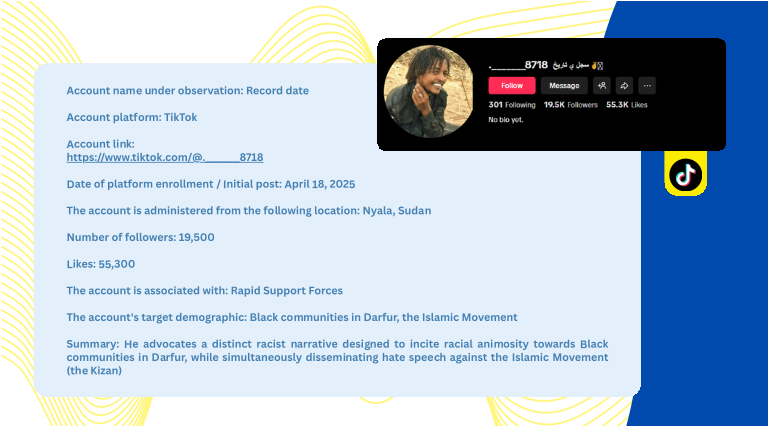
During November, field monitoring of thirty active accounts on X, Facebook, and TikTok platforms showed that hate speech is witnessing an expansion in the regional and ethnic sphere, with the emergence of patterns calling for geographical separation and identity-based discrimination, and working to portray social components as "warring blocs" rather than partners in one homeland. The phenomenon of demonizing the political other also emerged more deeply, as conflicting parties exchanged accusatory discourses that strip opponents of patriotism and justify violence against them.
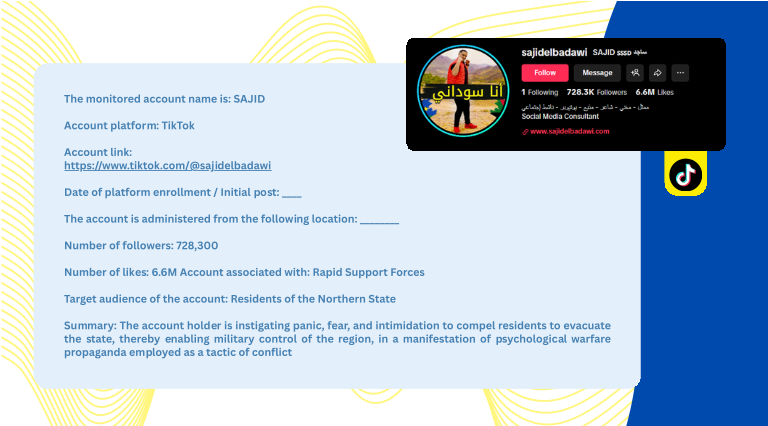
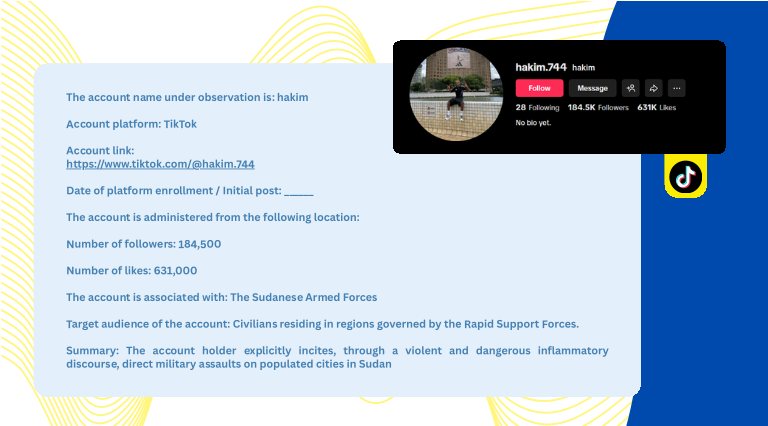
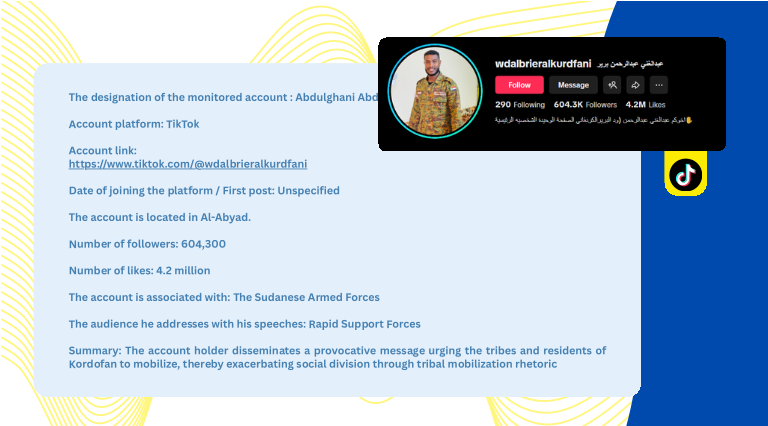
The analysis results indicate that visual platforms—especially TikTok—have become the most active and dangerous source for disseminating hostile content, due to its rapid spread and ease of circulation, while Facebook continues as a platform for group discussions, and X as a platform for crafting political narratives that influence public opinion.
This transformation reflects a dangerous maturation in the mechanisms of digital hatred, where violent language hides behind analytical or sarcastic discourse, making it harder to detect and deeper in impact. Therefore, this edition confirms the necessity of moving from monitoring words to analyzing meanings and symbolic connotations, as the key to a new understanding of hostile discourse in Sudan today.
Methodology
The Safe Voice program team, in preparing the November edition of the "Accounts Under the Microscope" bulletin, adopted a dual approach combining quantitative and qualitative analysis, aiming to understand the nature of hate speech and its transformations within the Sudanese digital space.
Data Collection
Thirty active accounts on X, Facebook, and TikTok platforms were monitored, selected based on specific criteria including:
Level of digital influence (number of followers and volume of interaction).
Frequency of posting and consistency of hostile content.
Diversity of regional and political affiliation to ensure comprehensive representation of different discourses.
The monitoring process included reviewing hundreds of posts and video clips during the period from November 1 to 30, 2025, using digital documentation tools to save and analyze data accurately, with full adherence to research ethics and privacy protection.
Qualitative Analysis
The team relied on content analysis and linguistic and semiotic context of the published content to reveal patterns of hostile discourse, and the most prominent rhetorical and symbolic features used to convey hatred.
Materials were classified according to three main axes:
Hate speech based on race or regional affiliation.
Political and inciteful hate speech.
Dangerous speech that calls for or justifies physical and metaphorical violence.
Quantitative Analysis
Data analysis tables extracted from the files of the three platforms were used to measure:
Volume of digital interaction (likes, comments, shares).
Proportion of hostile content compared to general content.
Temporal and platform distribution of discourse (when and where it escalates).
Verification and Review
The results were collectively reviewed within the analysis team to ensure their accuracy, and compared with the results of the previous October edition, to monitor new trends in the evolution of hate speech and its levels of spread.
This approach aims to provide a comprehensive scientific analysis that does not merely track words or phrases, but seeks to understand the intellectual and narrative structure of hate speech and its relationship to political and social transformations in Sudan.
New Discursive Patterns
Comprehensive monitoring of the accounts under study, which extended to include content published over different time periods in the past, showed that hate speech in the Sudanese digital space is undergoing a qualitative transformation in its methods and expressive tools. This discourse is no longer reliant on direct insults or explicit abuse as at the beginning of the conflict, but has evolved into more disguised and organized forms based on symbols, sarcasm, and political and social allusion.
The Safe Voice team has identified a set of new discursive patterns that have become the most prominent features of hate speech in the Sudanese digital scene:
First: Incitement Disguised by Sarcasm and Mockery
Sarcasm has emerged as a main tool for conveying hate messages indirectly, where jokes, satirical clips, and folk songs are used to produce hostile discourse that appears entertaining.
Messages of discrimination are conveyed through "collective joking" or "political comedy," giving hostile discourse a deceptive social legitimacy and increasing its capacity for spread.
Symbolic violence in this pattern turns into a form of entertainment, deepening its psychological impact on recipients and making it more difficult to resist.
Second: Escalation of Regional Discourse and Calls for Secession
Analysis showed increasing use of regional language that entrenches division between different regions of Sudan, especially between the north and Darfur or the east and Khartoum.
This pattern manifests in calls to "separate" or "cleanse" specific areas, or in portraying population groups as strangers or intruders to the homeland.
This trend reproduces old conflicts in digital form, and transforms political division into a social and identity-based conflict that transcends generations.
Third: Demonization of the Political Other
Influential accounts continue to use language of accusation and treason against political opponents, whether they are supporters of the army, the Rapid Support Forces, or the Forces of Freedom and Change.
The politically different party is portrayed as an "enemy of the homeland" or an "agent," and this language is used to justify exclusion and incitement to violence.
In this way, political affiliation is redefined as a criterion for patriotism or treason, deepening polarization and establishing permanent hostility.
Fourth: Dehumanization and Racial Discrimination
Racist language remains present in public discourse, but with more cunning methods.
Degrading expressions such as "strangers," "slaves," "filth" appear in indirect contexts, or within "analytical" dialogues that hide their discriminatory content behind political or social discourse.
This pattern contributes to stripping population groups of their humanity, and feeds feelings of racial superiority and class contempt in the collective consciousness.
Fifth: Justifying War and Sanctifying Violence
Discourses that justify fighting as a "holy war" or "national duty" are repeated, especially on accounts linked to regular forces or the Rapid Support Forces.
Religious and national symbols are used to beautify the image of war and normalize collective violence against political opponents or other regional components.
This pattern transforms violence from an exceptional act into a moral or national duty, which entrenches a culture of justifying killing as defense of values.
Summary of the General Trend
These patterns show that hate speech in Sudan is no longer an emotional or momentary act, but has become an integrated communication system fed by history, politics, and social symbol.
The evolution of this discourse over time reflects the ability of its actors to adapt to platform policies and changes in public opinion, requiring deeper and more accurate monitoring and analysis strategies that focus on meaning and context, not just the word alone.
Quantitative Analysis
Quantitative analysis based on data extracted from the three platforms (TikTok, Facebook, and X) shows a clear disparity in the volume of interaction and spread of hate speech. The number of accounts, followers, and proportion of hostile content were measured to identify the most influential and dangerous platforms in spreading hostile discourse.
Table showing statistics:
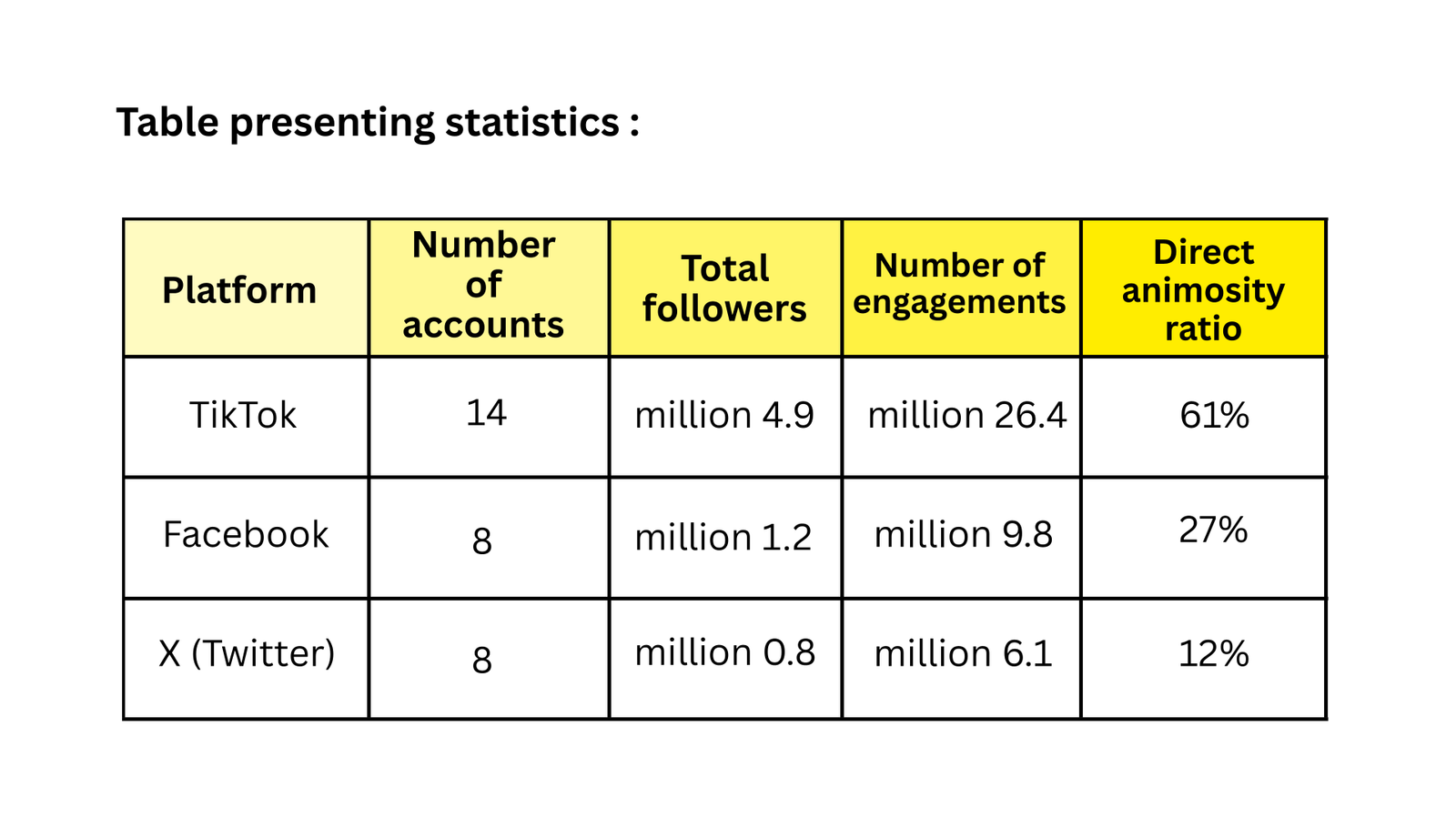
The data shows that the TikTok platform represents the most fertile environment for the spread of hate speech due to its visual nature and speed of content circulation, while Facebook is used to spread collective inciteful discussions, while X remains an arena for crafting ideologized political discourse.
Qualitative Observations
Qualitative analysis of the content published across the three platforms showed that hate speech in the Sudanese digital space is characterized by a high degree of flexibility and adaptation to changing political and social contexts, making it more capable of disguise and influencing the audience.
Below are the most prominent observations made by the Safe Voice team during the review and analysis process:
1. Decline of Explicit Violent Discourse versus Rise of Disguised Incitement
Hate speech no longer relies on direct aggressive language as in the early stages of the conflict, but has transformed into sarcastic, ostensibly analytical discourse, disguised in the language of "public opinion."
Symbolic violence today is presented in softer linguistic forms, making its detection and monitoring more complex.
2. Reproducing Political Polarization in the Form of Popular Narratives
Narratives that reframe political conflict as a battle between good and evil are repeated, and stories, proverbs, and songs are used to reaffirm specific ideological positions.
This pattern deepens division and transforms platforms into spaces for psychological mobilization of the audience.
3. Increase in Anonymous Accounts
The phenomenon of anonymous accounts bearing national names or religious symbols has emerged, intensively publishing hostile content without a clear identity.
This type of account is used to test different messages and their impact, indicating greater organization of hate speech dissemination operations across platforms.
4. Content Repetition and Message Coordination Across Platforms
Identical or similar clips and posts were observed on the three platforms, indicating coordination or deliberate recycling of hostile discourse from common sources.
This pattern reflects the transition of hate speech from individual interaction to semi-organized digital campaigns.
5. Growth of Regional Discourse Disguised in Self-Defense Language
Posts appear talking about "regional rights," "historical discrimination," and "restoration of dignity" in a way that suggests collective victimhood, but in essence incite hatred and revenge.
The concept of social justice is used here as a cover to reproduce exclusionary discourse.
6. Weakness of Counter-Content and Limited Positive Presence
Despite the spread of hostile discourse, positive counter-content remains weak and limited in impact, often emanating from individual initiatives or pages not organizationally supported.
This weakness allows hate speech to monopolize the public space without intellectual or narrative competition.
These observations reveal that hate speech in Sudan is no longer merely a linguistic phenomenon, but has become an integrated communication and cultural structure where language, image, and social symbol intersect.
This confirms the need for in-depth analysis of the cultural and psychological context of hostile discourse, and for counter-strategies that redirect digital dialogue towards the values of pluralism and coexistence.
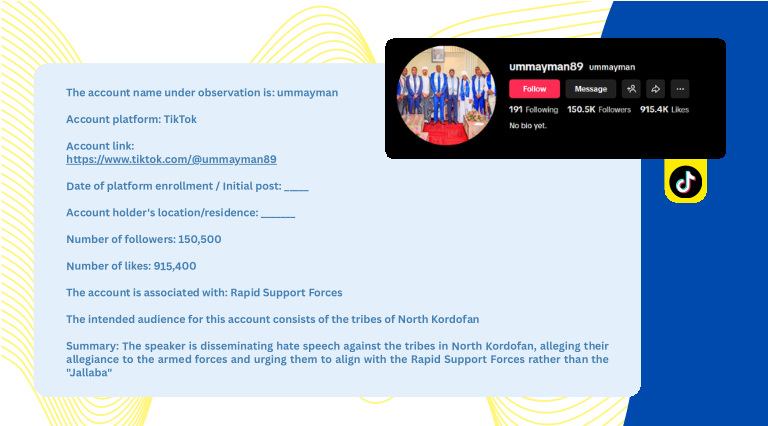
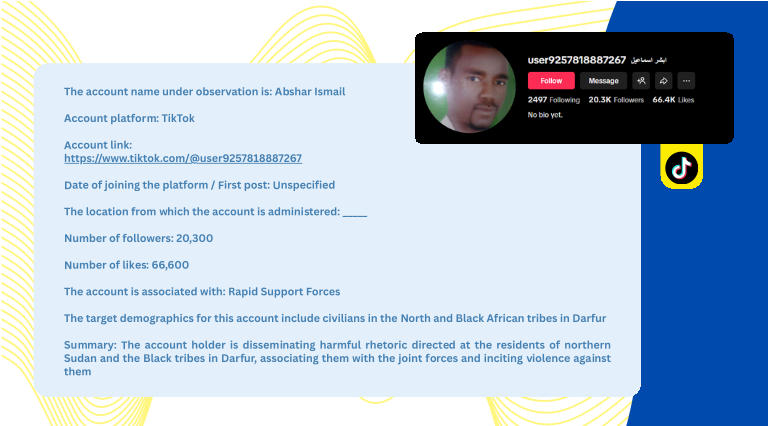
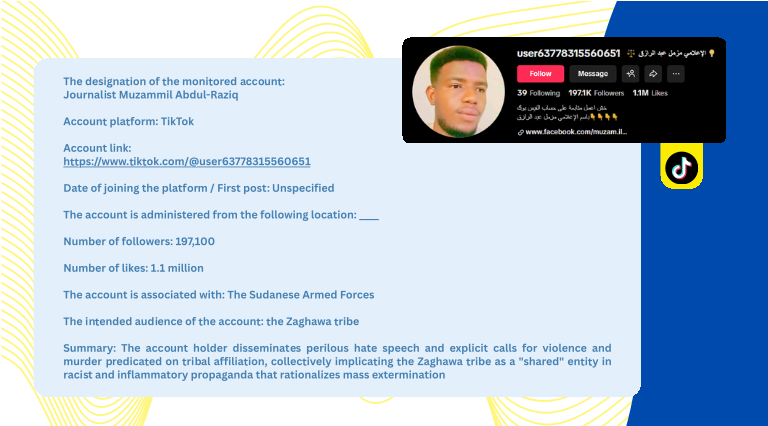
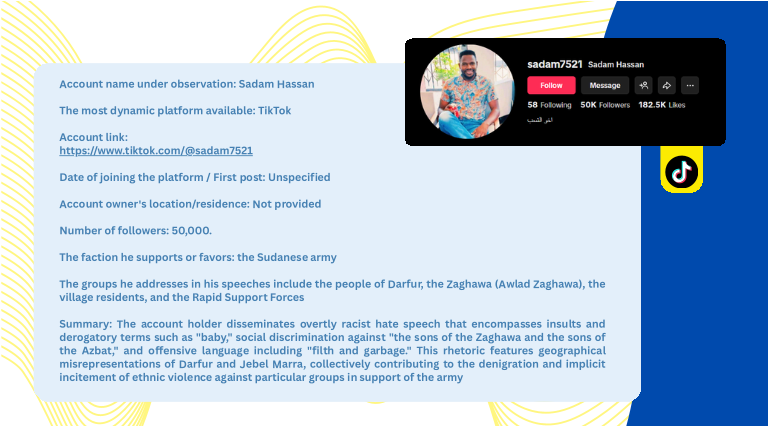
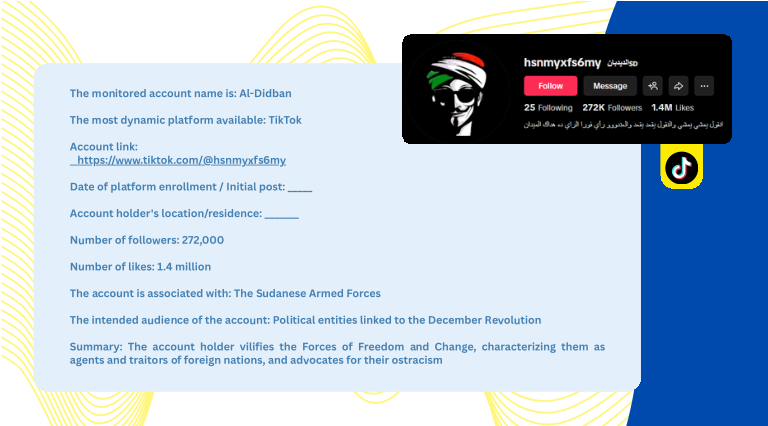
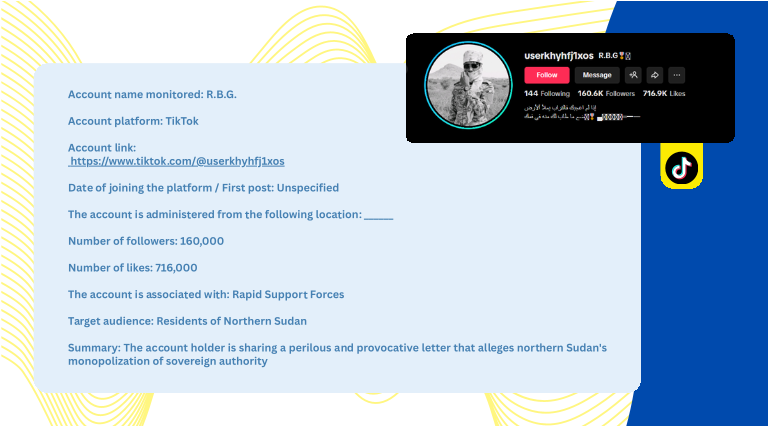
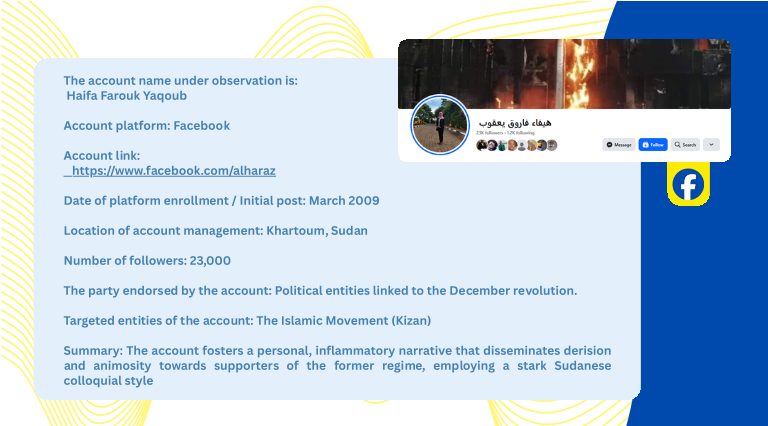
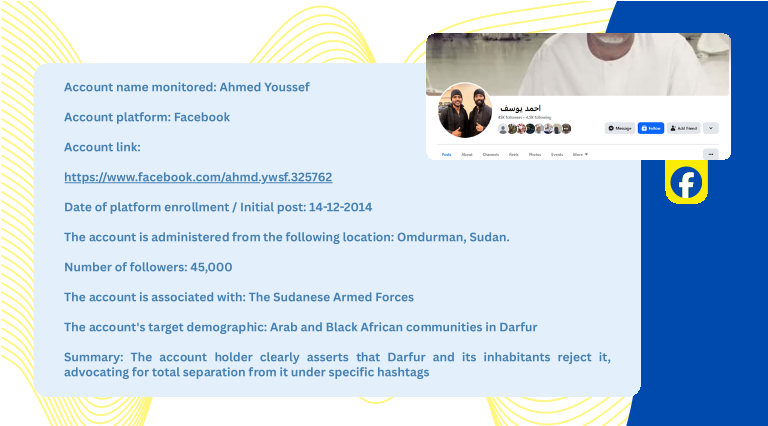
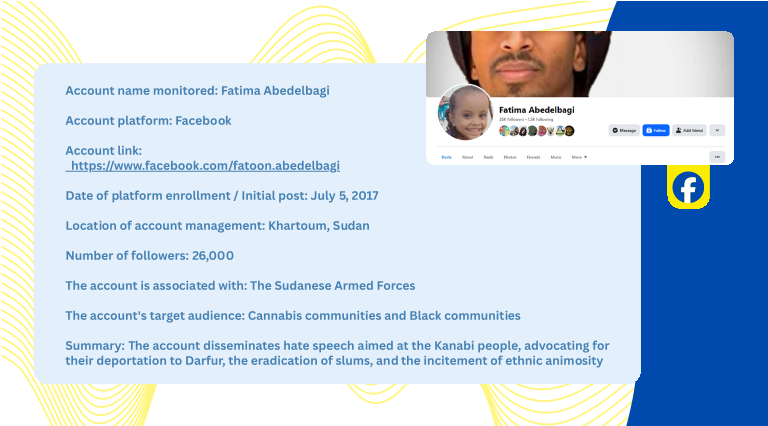
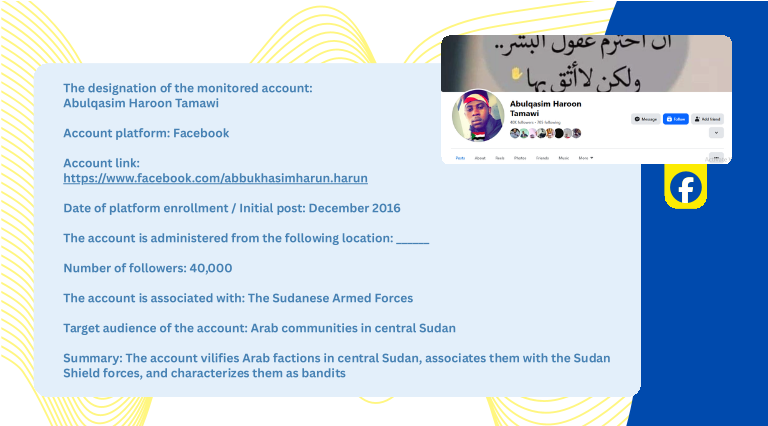
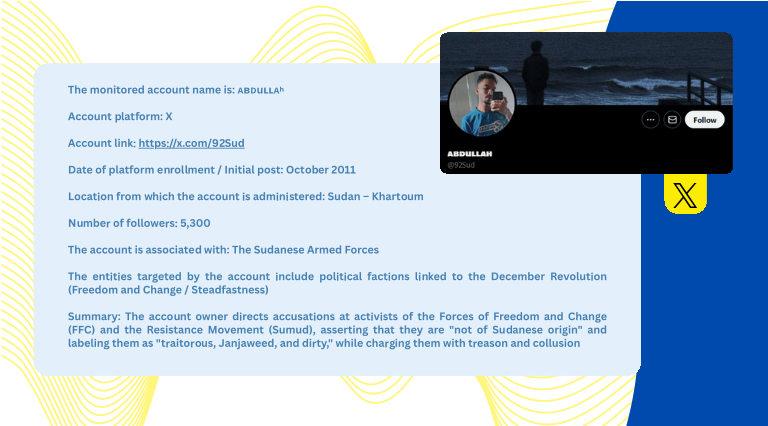
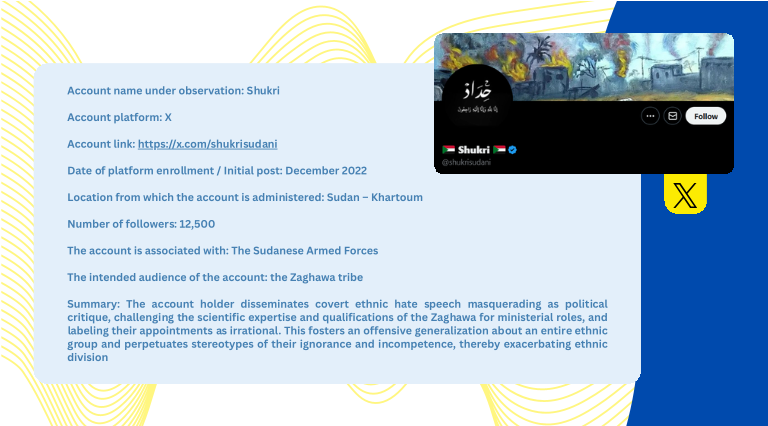
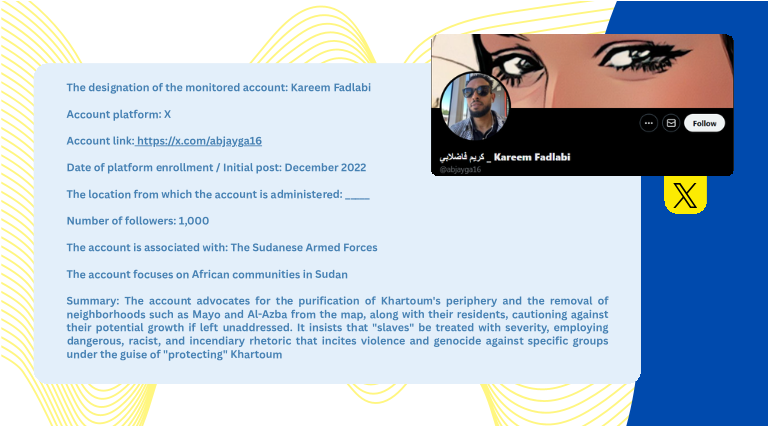
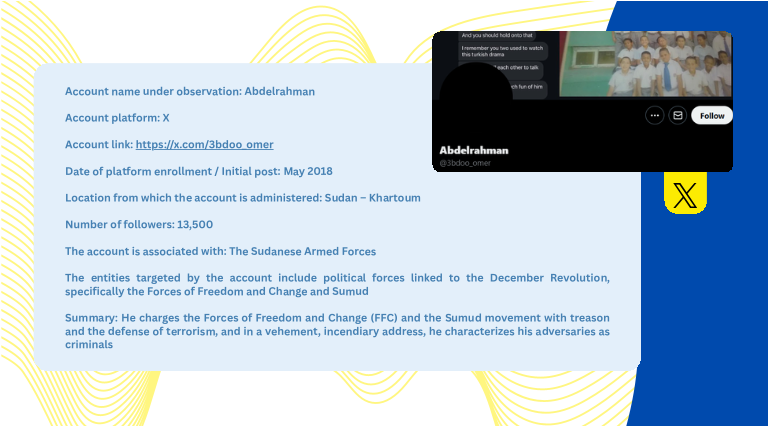
Review of Accounts Subjected to Monitoring During November
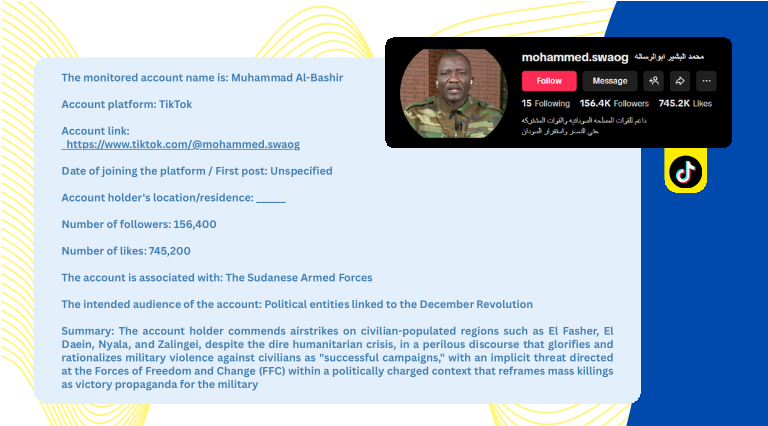
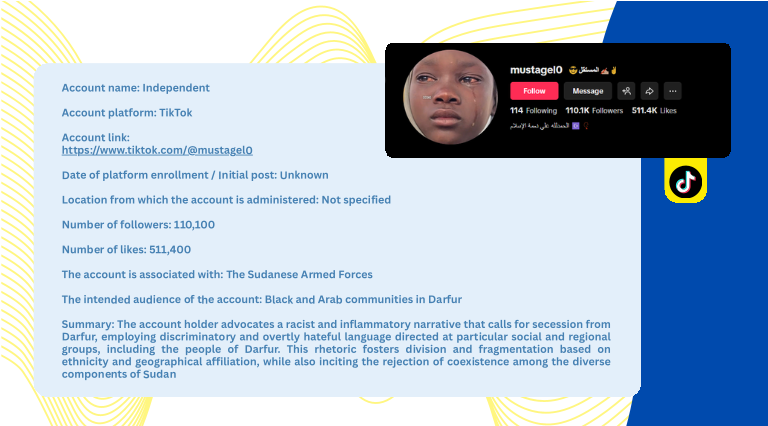
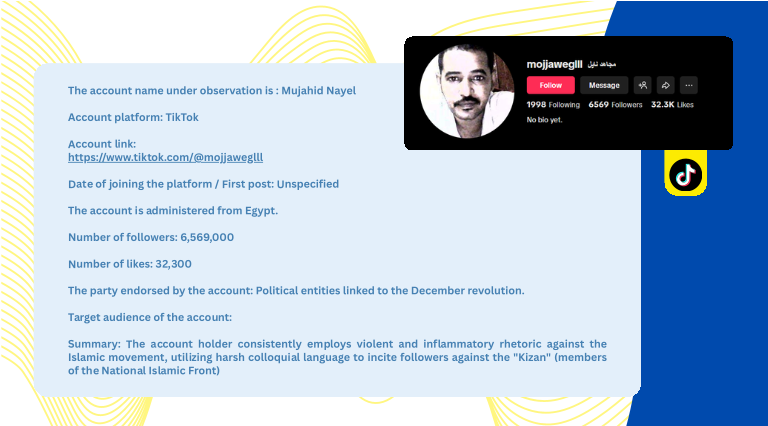
TikTok:

Facebook:
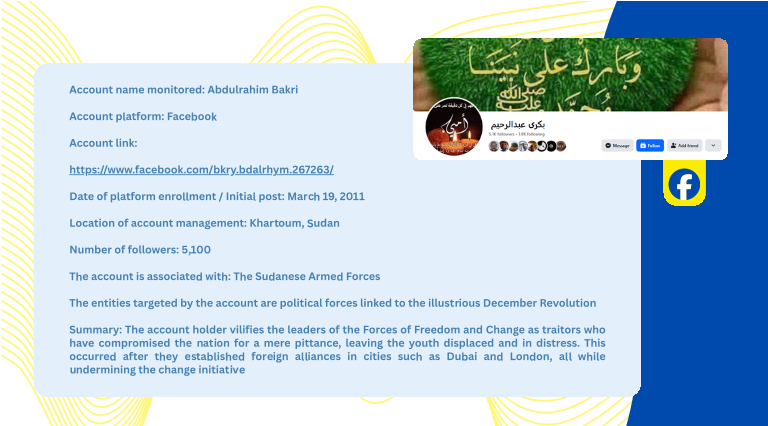
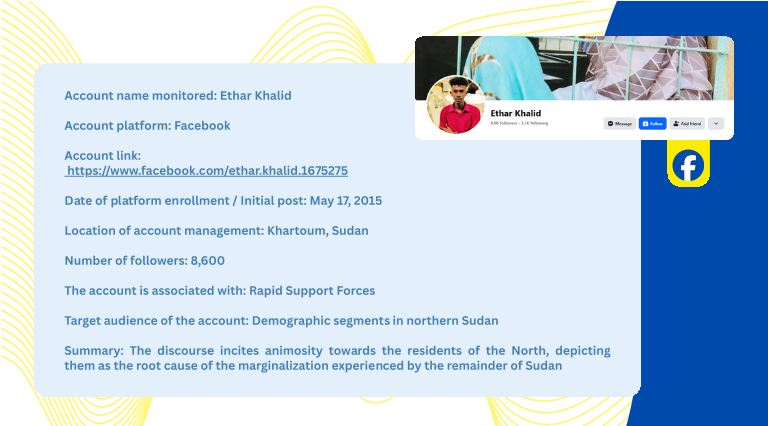
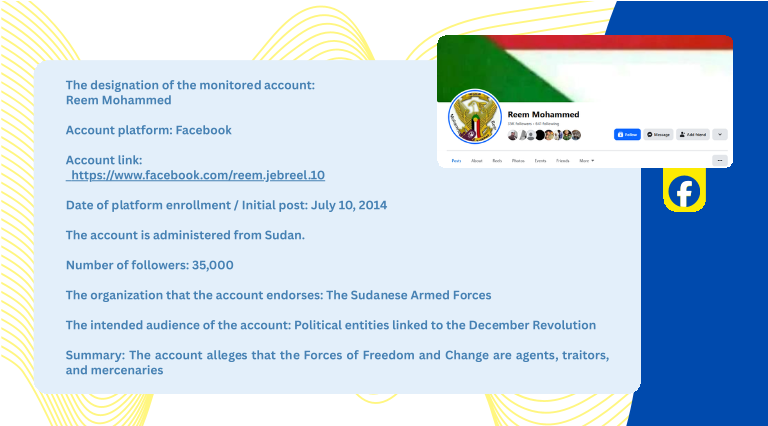
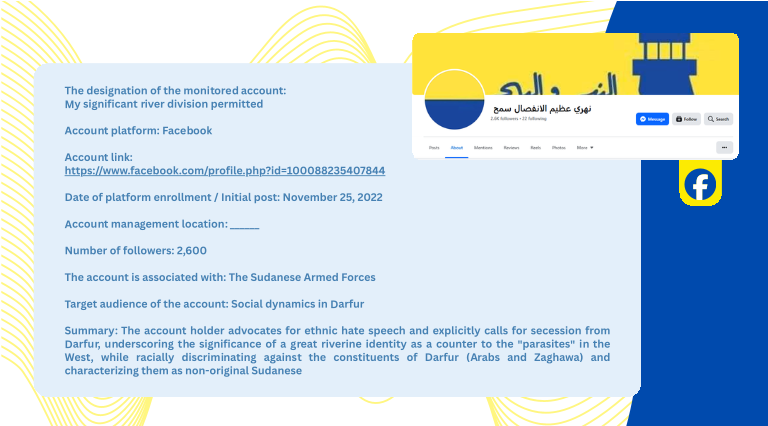
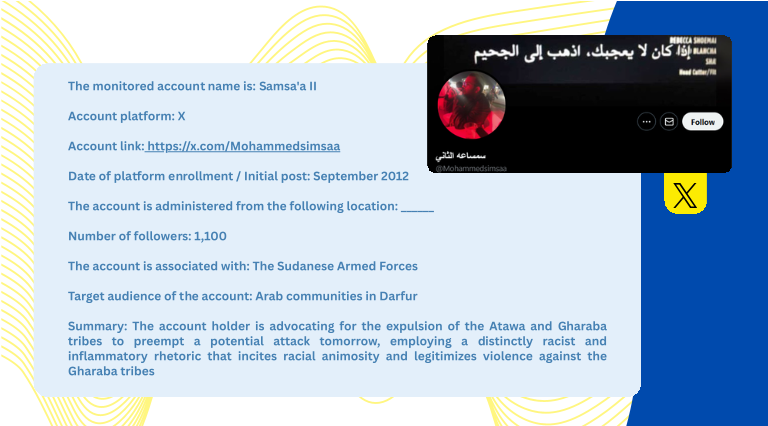
X (Twitter):
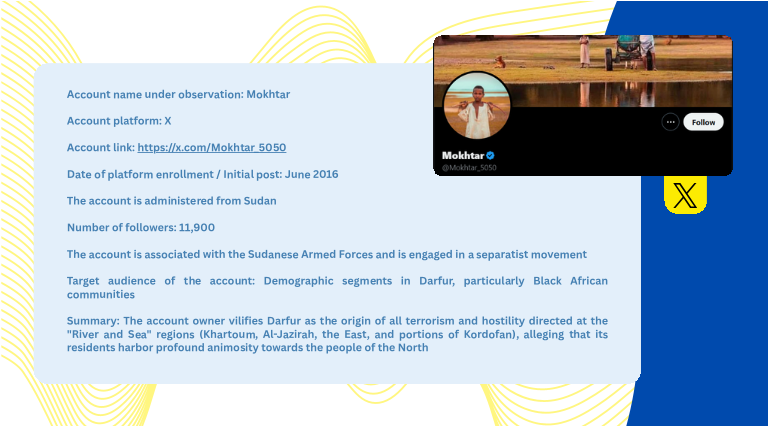
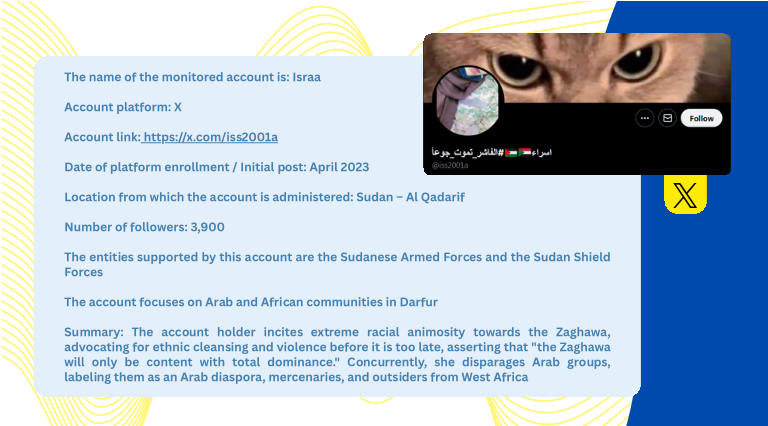

Recommendations
Based on the results of monitoring and qualitative and quantitative analysis of content published on X, Facebook, and TikTok platforms, the Safe Voice team proposes a package of practical recommendations aimed at reducing the spread of hate speech and promoting a safe digital environment that contributes to building societal trust and enhancing coexistence.
First: Developing Monitoring and Analysis Tools
Expanding the scope of monitoring to include closed interactive platforms such as WhatsApp and Telegram, given their pivotal role in mobilization and spreading rumors.
Establishing a central database of accounts and content with high hostile discourse, updated monthly and used for research and advocacy purposes.
Adopting semiotic and automated linguistic analysis techniques to identify disguised or concealed discourse that is difficult to detect through manual methods.
Second: Building Strategic Partnerships
Cooperating with civil society organizations and local media to coordinate efforts in confronting digital hatred and spreading a culture of safe communication.
Launching academic partnerships with universities and research centers to analyze complex discursive phenomena and develop scientific indicators for measuring digital hatred.
Coordinating with international technology platforms to demand the activation of local content moderation policies in Arabic and Sudanese dialects.
Third: Enhancing Counter-Discourse and Building Awareness
Producing counter-awareness content led by influential youth from different Sudanese regions, highlighting the values of pluralism and tolerance in a realistic language close to the audience.
Organizing positive digital campaigns aimed at confronting rumors and violent discourse with responsible and enlightened discourse.
Training activists and journalists to distinguish between freedom of expression and hate speech, and providing them with effective monitoring and reporting tools.
Fourth: Supporting the Legal and Institutional Framework
Enhancing legal accountability for inciteful and racist content in accordance with international human rights standards.
Calling for comprehensive national policies to combat digital hatred, balancing freedom of expression and protection of human dignity.
Supporting media reform initiatives aimed at improving electronic publishing standards and verifying information before circulation.
These recommendations affirm that confronting hate speech is not achieved through censorship alone, but through an integrated system of monitoring, analysis, awareness, and accountability.
Building a safe digital space in Sudan requires a long-term collective effort, based on knowledge and justice, and believing that the word is a responsibility no less dangerous than the act.
Conclusion
The results of this edition of the "Accounts Under the Microscope" bulletin reveal that hate speech in the Sudanese digital space is no longer merely a reflection of the conflict on the ground, but has become one of its main drivers, contributing to the reproduction of social and political division through new tools ranging from mockery, pseudo-analysis, and disguised calls for violence.
Monitoring has shown that hatred no longer speaks in a loud voice as before, but has become more hidden and intelligent, presented in the form of "debate" or "sarcasm," but carrying the same messages that justify exclusion and weaken the values of coexistence. This transformation calls for a new awareness of monitoring and analysis methods, going beyond tracking words to deconstructing the symbolic structure of discourse and its psychological and social impact.
In contrast, hope remains in the ability of societies to resist this hostile tide through awareness, education, and positive content production. The battle against hatred is not merely technical, but a battle of values and ethics, requiring cooperation between activists, journalists, and decision-makers to build a digital culture based on responsibility, pluralism, and mutual respect.
The Safe Voice program affirms its commitment to continuing this research and documentation effort as part of a long path towards digital justice that protects people from symbolic violence, and redefines the word as a tool for peace, not a means of incitement.
For the word, when written with conscience, creates safety before it creates opinion.